
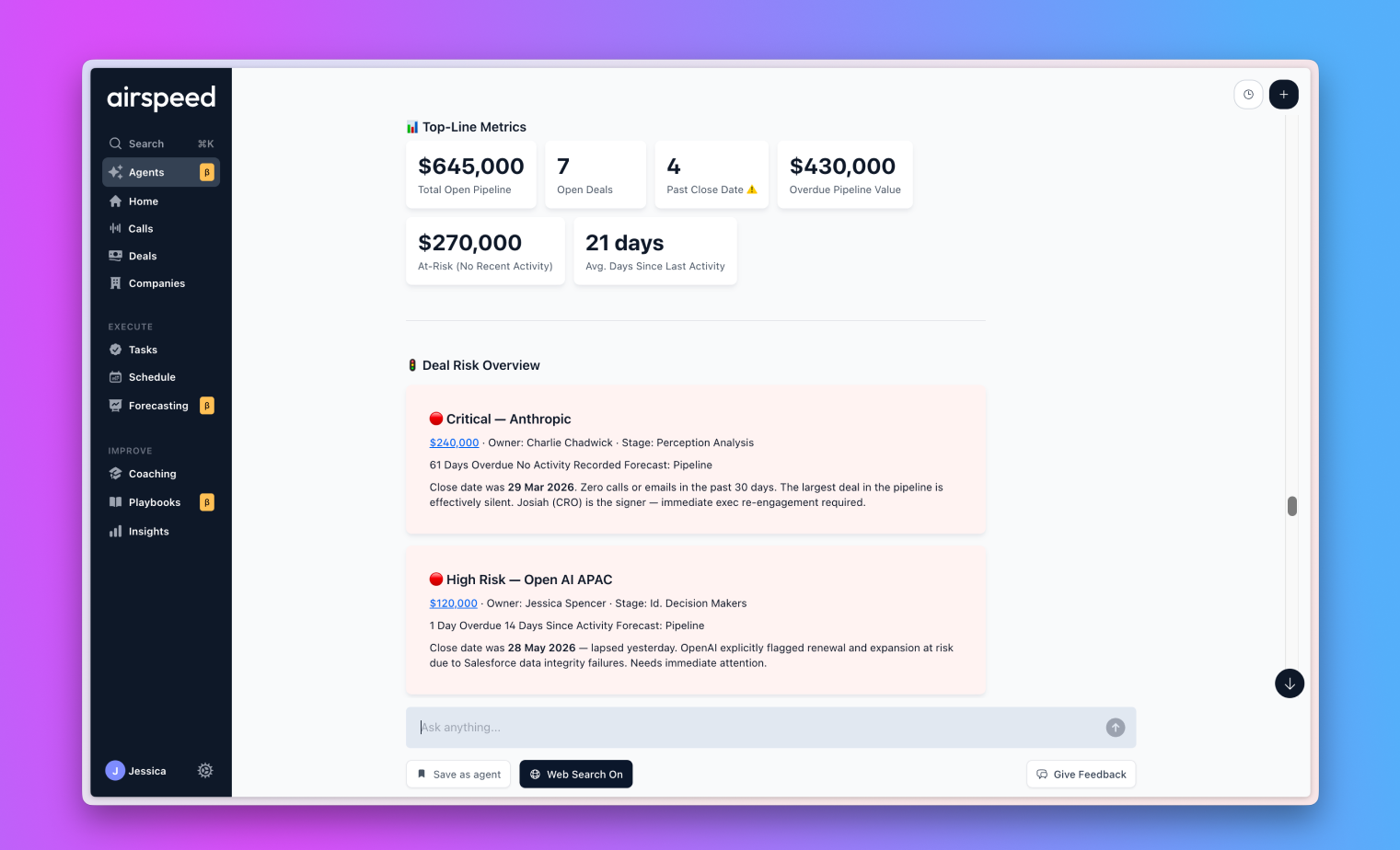
Airspeed’s Deal Risk Agent reads the calls, the emails, and the CRM history on every open deal, then names what is slipping while you can still fix it. A buyer who stopped replying. An economic buyer who never appeared. A next step whose date passed two weeks ago. It does not stop at the flag: it drafts the follow-up, updates the CRM, and posts the play to Slack.
Why do healthy-looking deals end in closed lost?
Collecting the data stopped being the problem a long time ago. Every rep, every manager, every CRO is sitting on more of it than they could read in a lifetime. Calls, emails, threads, notes, CRM fields, all of it piling up.
The real challenge is cutting through the noise and working out how a deal is actually doing. AEs, sales managers, and CROs are bombarded, and the signal gets buried. So the deal that looked healthy on Friday quietly rots over the weekend, and nobody notices until it lands in closed lost.
The information was almost always there. It was sitting in a call from three weeks ago that nobody had a reason to replay, which is exactly how good deals stall quietly. The Deal Risk Agent closes that gap by reading the conversations between seller and buyer alongside the CRM record, and reporting what changed.
What does a slipping deal look like?
Deals rarely die loudly. They go quiet. Four signals show up before almost every loss, and none of them appear in the stage field.
| Signal | What you would see | What it usually means |
|---|---|---|
| The buyer has gone dark | Last inbound reply on the 3rd, three unanswered follow-ups since | Not a deal waiting on procurement. A deal cooling off. |
| You are single threaded | Your champion is the only person engaged, no economic buyer on a single call | One relationship is not a deal, it is a favor |
| Next steps have expired | Tasks sitting in the CRM with completion dates that came and went | On paper it is progressing. It stalled two weeks ago. |
| The story does not add up | The buyer mentioned a budget freeze on the call, the deal is still in commit | Somebody is telling the forecast a story it wants to hear |
The single-threading one is worth dwelling on. Buying groups now run from five to 16 people across as many as four functions, according to Gartner, and Gartner also found that 74% of B2B buying teams show “unhealthy conflict” during the decision process. Your champion is arguing your case in a room you have never been in. If they are the only name on the thread, they are selling your deal without you.
How does the Deal Risk Agent work?
It runs the same loop a great deal reviewer would run, on every deal, all the time.
- It gathers the evidence. Calls, emails, CRM history, and the deal timeline, without asking the rep to lift a finger.
- It tests the story against your framework. MEDDIC, SPICED, or something custom to your team. It finds what is missing, not just what was said.
- It names the risk. A plain language explanation of what changed, when, and why it matters this quarter.
- It closes the case. Drafts the follow-up email, updates the CRM, and posts the play to Slack so the whole team can move.
Step four is the part that separates an agent from a dashboard. A risk score hands your rep more work. This closes the task instead. See agents for how the rest of them are built and run.
What you see when you open Airspeed
Every deal in flight, in one view, with issues in the MEDDIC process flagged automatically. A paper process that is quietly stalling does not hide anymore. It gets surfaced the moment it starts to drift, on the deal management board.
Your CRM fields brought right in, editable and movable just like HubSpot or Salesforce. No tab switching, no copy paste, no second source of truth. The fields you live in are right there, which is what keeps the CRM current without a rep typing.
Custom deal warnings, bespoke to your business, with close probability broken down in real detail. In the early stages that read is often around 40% more accurate than a rep’s own gut call, because it is working from what actually happened rather than what everyone hopes will happen. That read feeds forecasting too.
No setup needed to get value. Ask a question like “who is the buyer in this deal?” and the agent runs through every contact, call, and email to answer. Ask the deal a question, get a straight answer. There is more on that walkthrough here.
What do teams get back?
Published numbers from Airspeed customers, each tied to a story you can read in full.
- 50 hours a month back across the sales team at Scaleup Finance.
- 60% less manual admin time at FERMÀT, with 10x revenue productivity.
- CRM data quality from a D to an A at Persona.
All three come from the same place: the work after the call stopped landing on a rep’s Monday list. Sales leaders and RevOps tend to read that list differently, and both readings hold.
Already paying for Gong, Clari, or Jiminny?
If you are locked into a contract, you do not have to wait it out. Airspeed is free until your current contract ends, plus free data migration to get you moved over with none of the usual pain.
If you are still weighing it up, the side-by-side pages are the honest version: Airspeed vs Gong, Airspeed vs Clari, and Airspeed vs Jiminny. For the wider field, see the best deal intelligence platforms.
See it on your own pipeline
The best way to believe it is to point it at your own deals and watch it work. Bring the deal you are least certain about.
Book a demo, or book through the Deal Risk Agent campaign page and collect a $100 gift card for taking the call.
Want the two minute version?
Watch the walkthrough:
- 0:00 Collecting data was never the problem
- 0:20 Every deal in flight, in one view
- 0:35 MEDDIC issues surfaced automatically
- 0:55 CRM fields, brought right in
- 1:10 Custom deal warnings and close probability
- 1:40 No setup? Just ask the deal a question
Frequently asked questions
What is the Deal Risk Agent?
An Airspeed agent that reads the calls, emails, and CRM history on every open deal, tests what it finds against your qualification framework, and names the risk in plain language. It then acts on it, drafting the re-engagement email, updating the CRM, and posting the play to Slack.
What risks does it actually catch?
The four that precede most closed lost deals. A buyer who has gone quiet while follow-ups pile up, a deal running on one contact with no economic buyer in sight, next steps whose completion dates have passed, and a mismatch between what was said on the call and what the CRM stage claims.
Does it work with MEDDIC?
Yes, and with SPICED or a framework of your own. The agent maps the evidence from conversations onto the framework your team already sells with, so it reports a missing economic buyer or a stalled paper process rather than a generic risk score.
How accurate is the close probability?
Airspeed has found it can often be around 40% more accurate than a rep's own call, and the gap is widest in the early stages, where a rep is judging from two conversations while the model is judging from every comparable deal the team has run.
How much setup does it need before it is useful?
None to start. Custom warnings and scoring reward configuration, but you can open any deal and ask a question such as who the buyer is, and the agent works through the contacts, calls, and emails to answer.
We are already under contract with Gong, Clari, or Jiminny. Can we still switch?
Yes. Airspeed is free until your current contract ends, and data migration is free, so you are not paying twice to move.