
Collecting the data stopped being the problem a long time ago. Understanding what is actually going on in a deal, quickly, is the problem. Airspeed reads the calls and emails against your qualification framework, flags where the deal is stuck, keeps your CRM fields alongside, and answers a direct question about any deal with no setup first.
Why more data has not made deals clearer
AEs, sales managers and CROs are bombarded. Call recordings, email threads, CRM fields, dashboards, notifications from four tools. The volume went up and the clarity did not, because none of those sources knows about the others. Cutting through the noise to work out how a deal is really doing has quietly become one of the more expensive tasks in the job.
That is the gap. The information needed to know a deal is in trouble almost always exists already, sitting in a call from three weeks ago that nobody has a reason to replay. What is missing is anything that reads across the conversations, the emails and the CRM record at once and says what changed.
Airspeed brings that context together in one place, which is what makes the next few things possible.
What the deal view actually surfaces
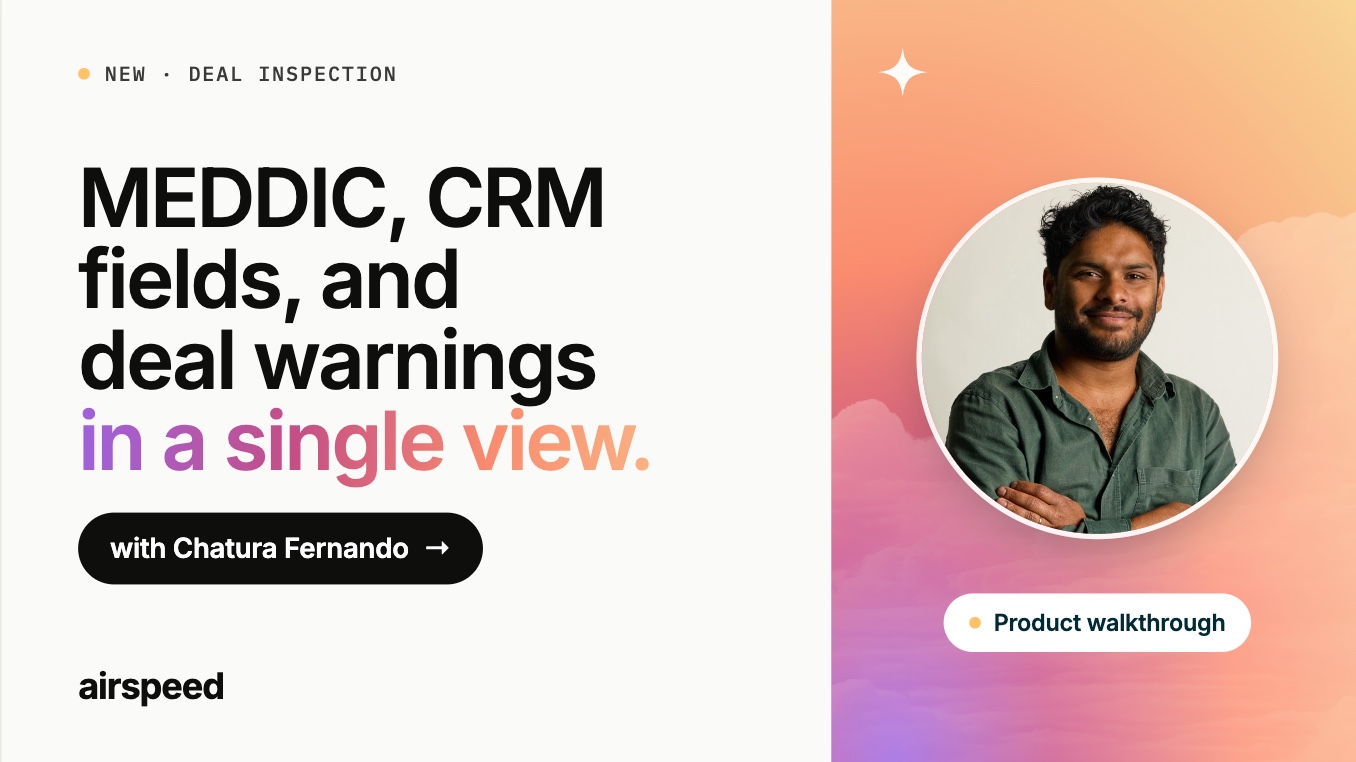
Start with every deal in flight in one view. Underneath each one, Airspeed uses the emails and calls, the real back and forth between seller and buyer, to identify issues in your MEDDIC qualification rather than just recording a stage name.
The value is in how specific that gets. Instead of a deal marked healthy because nobody updated it, you see immediately that, say, the paper process is the problem on this one. That is a different kind of statement from “stage: negotiation.” It names the blocked step, which is the only version of the information a rep can act on this week.
From there you can go deeper into the deal and see what the assessment rests on. The conclusion is not the end of the trail, it is the start of it.
Your CRM fields come with it
The fields from your CRM appear on the deal alongside everything drawn from the conversations, and they behave the way you expect: editable, movable, much the same as working in HubSpot or Salesforce directly.
This matters more than it sounds, because the alternative is the thing that kills adoption of every deal tool. If the conversation intelligence lives in one system and the deal record lives in another, somebody has to reconcile them, that somebody is the rep, and the reconciliation does not happen. Carrying the CRM fields in the same view means there is one place to look and one place to edit.
It also means the structured data and the conversational evidence sit next to each other, which is the arrangement that makes a discrepancy obvious. A close date that says this month next to a paper process that has not started is a question that asks itself.
Custom warnings, and a close probability worth arguing with
On top of the qualification signals, Airspeed layers deal warnings that are built for your business rather than pulled from a generic template. Because they are bespoke per customer, they can encode the specific patterns your team loses to, which is what separates a warning people act on from one they learn to ignore.
Close probability is the clearest example. It goes into real detail on why a deal looks likely to come in or not, rather than producing a number with nothing behind it. Airspeed has found this can often be around 40% more accurate than the rep’s own call, and the gap is widest in the earlier stages. That makes sense: early on, a rep is judging from two conversations and a good feeling, while the model is judging from every comparable deal the team has run.
The point is not to overrule the rep. It is to give the forecast conversation something to be about.
You do not have to set anything up first
All of that rewards configuration, and configuration is exactly what a team evaluating a new tool has not done yet. So none of it is a prerequisite.
Go into any deal and ask a question directly. “Who is the buyer in this deal?” The model runs through the contacts, the calls and the emails and comes back with the answer quickly. No fields to map, no framework to define, no admin project to schedule before the thing is useful.
That is the honest on-ramp for most teams. Ask questions of deals you already have, see whether the answers hold up against what you know, and set up the warnings and scoring once you trust the underlying read. The setup earns its keep, but it should not stand between you and finding out whether this works.
Three things worth asking your own pipeline
- On a deal you feel good about: who is the buyer, and when did they last appear in a conversation?
- On a deal that has slipped: what changed between the last two calls with this account?
- Across the board: which deals show a blocked paper process while still carrying a close date this quarter?
If the answers surprise you, that is the finding. The information was already in your calls and your inbox. It just had nowhere to surface.
Want to point this at your own deals rather than a demo account? Book a demo and bring the deal you are least certain about. For how the board and the agents work alongside this, see deal management and agents.
Frequently asked questions
What does Airspeed show about a deal that a CRM does not?
It reads the calls and the email back and forth between seller and buyer, then maps what it finds onto your qualification framework. That surfaces issues nobody typed into a field, such as a stalled paper process, and lets you open the deal to see what the conclusion is based on.
Does it replace my CRM fields?
No, it carries them. Your CRM fields appear on the deal alongside everything drawn from conversations, and they can be edited and moved the same way you would in HubSpot or Salesforce, so there is no second system to keep current.
What are custom deal warnings?
Risk signals defined for your business rather than generic ones. Because they are bespoke per customer, they can encode the patterns your team actually loses to, and they explain in detail why a given deal looks likely or unlikely to land.
How accurate is the close probability?
Airspeed has found it can often be around 40% more accurate than a rep, and the gap is widest in the earlier stages, which is exactly where a rep has the least evidence to judge from.
Do we have to configure all this before it is useful?
No. Warnings and scoring reward setup, but you can skip straight to asking. Open any deal and ask something like who the buyer is, and the model works through the contacts, calls and emails to answer.
Who is this for, reps or managers?
Both, at different scopes. A rep asks about one deal before a call. A manager or CRO reads the board to see which deals across the pipeline share a risk pattern. It is the same underlying record either way.