Best Deal Intelligence Platforms for 2026: 7 Tools Compared

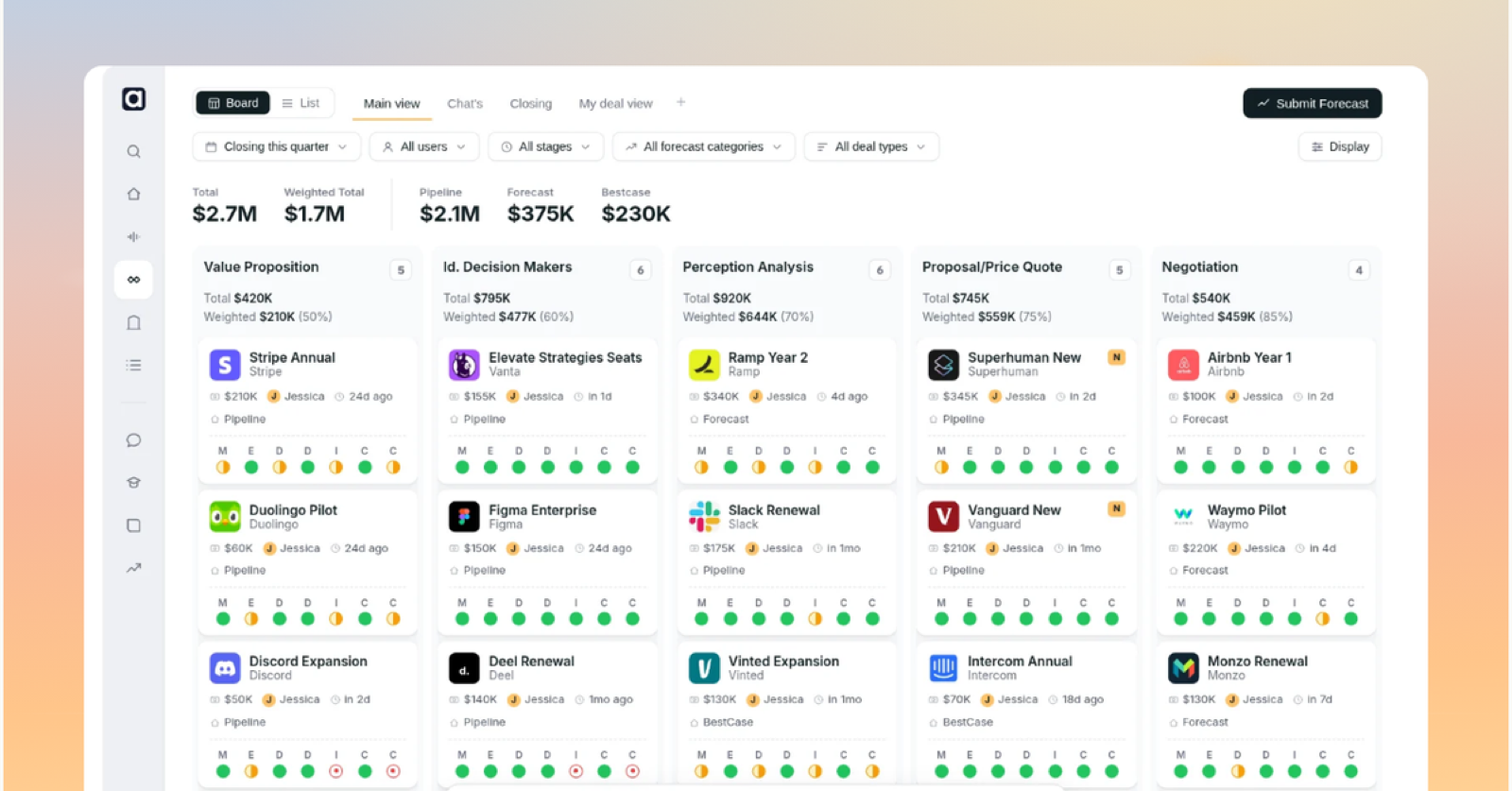
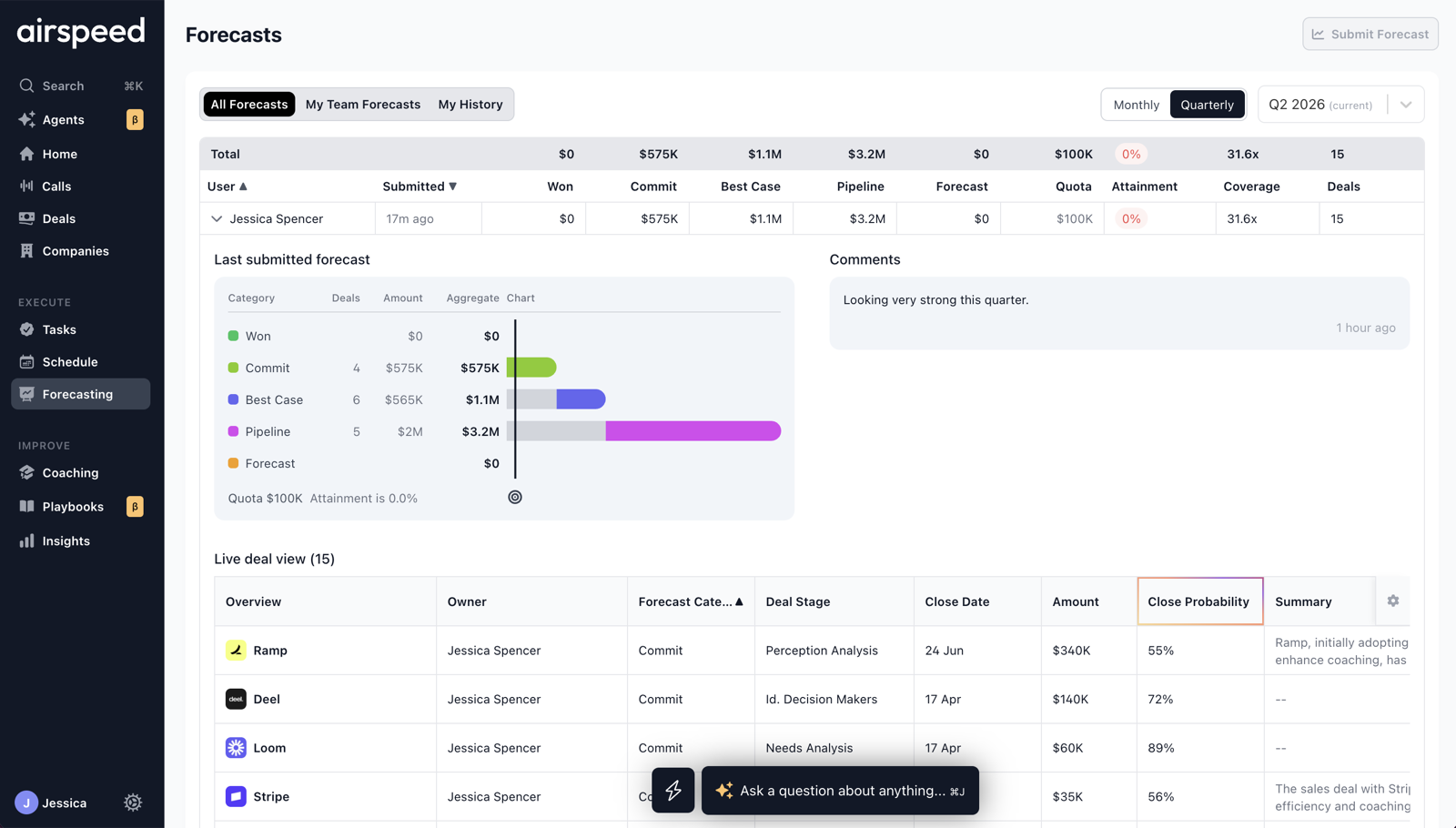
Deal intelligence is the opportunity-level scoring and risk layer that sits between call-level conversation intelligence and the broad revenue-intelligence umbrella. Instead of trusting a rep-entered stage or a gut-feel commit, a deal intelligence platform reads the real activity inside every open opportunity - calls, emails, meetings, calendar invites, and CRM updates - to score deal health, flag risk signals like single-threading or stakeholder ghosting weeks early, and roll that into pipeline and forecast health. This guide compares the seven best deal intelligence platforms for 2026 across signal coverage, automatic activity capture, forecast methodology, segment fit, action versus observation, and total cost of ownership. Our pick is Airspeed, the AI-native option that pairs framework-aware deal scoring with autonomous CRM action - AI agents for revenue teams - so insights actually change deal outcomes rather than just lighting up a dashboard.

Last updated June 2026

What to Look For in a Revenue Intelligence Platform

Evaluate any platform against these criteria before you commit.

Signal coverage and scoring quality: does it ingest calls, email, calendar, and CRM activity to score every open deal across many leading-indicator signals, rather than just reading the CRM stage?

Automatic activity capture and CRM fit: native, no-manual-entry capture and field-level sync for your system of record (Salesforce vs. HubSpot), since deal intelligence is an analytical layer on top of the CRM

Forecast accuracy and methodology: bottom-up AI or behavioral forecasting that removes rep-submission bias, with scenario modeling and a documented accuracy lift

Deal-cycle and segment fit: long, multi-stakeholder enterprise cycles need time-series models and buying-committee mapping, while shorter mid-market cycles need lighter, faster tooling

Action vs. observation: does it just flag risk on a dashboard, or does it route alerts, trigger plays, and drive next steps so insights change outcomes?

Pricing transparency and total cost of ownership: per-user pricing plus platform fees, modular vs. bundled, implementation timeline, and adoption design

How We Evaluated These Tools

We define deal intelligence as the opportunity-level scoring and risk layer that sits between call-level conversation intelligence and the broad revenue-intelligence umbrella. We evaluated each platform hands-on and against vendor documentation, public pricing, and verified user reviews, scoring them on the dimensions that matter to the buyers who actually run pipeline - CROs, RevOps, and sales leaders - rather than feature-count checklists.

What we scored

  • Signal coverage and deal-health/win-probability scoring quality across calls, email, calendar, and CRM activity
  • Automatic activity capture and depth of CRM integration (Salesforce and HubSpot)
  • Forecast accuracy and methodology: bottom-up behavioral forecasting that removes rep-submission bias
  • Fit to deal-cycle length and company segment (SMB, mid-market, enterprise)
  • Action vs. observation: alerting, play routing, and agentic automation on risk signals
  • Pricing transparency, total cost of ownership, implementation timeline, and adoption design

Sources

  • Vendor documentation and pricing pages, reviewed June 2026
  • G2 and Capterra reviews and ratings
  • Third-party pricing aggregators (Capterra, SalesHive, Vendr-style estimates), June 2026
  • 2026 buyer-facing deal-intelligence comparison guides and category explainers

Last verified June 2026. We refresh pricing and feature data quarterly.

Our Top Pick: Airspeed

After evaluating every option, Airspeed stands out for teams that want automation - not just analytics.

Editor's Pick

Airspeed

AI-native GTM execution platform that turns every sales conversation into deal intelligence and autonomous CRM action.

PriceSales-led; annual contracts estimated to start around $10K/year. Contact sales for a quote.
Best ForMid-market revenue teams that want deal intelligence plus execution - automated CRM hygiene, deal scoring, and risk alerts grounded in real conversations - rather than a pure analytics or call-recording tool.

Pros

  • Deal scoring and risk signals are framework-aware (MEDDIC/BANT/SPICED) and surface a precise reason plus a next step, not just a red flag
  • Field-level CRM auto-sync to Salesforce and HubSpot (20+ fields populated from calls), eliminating manual data entry and saving reps 5-10 hours per week
  • Pipeline inspection that layers conversational context, activity recency, qualification gaps, and deal risk onto every opportunity
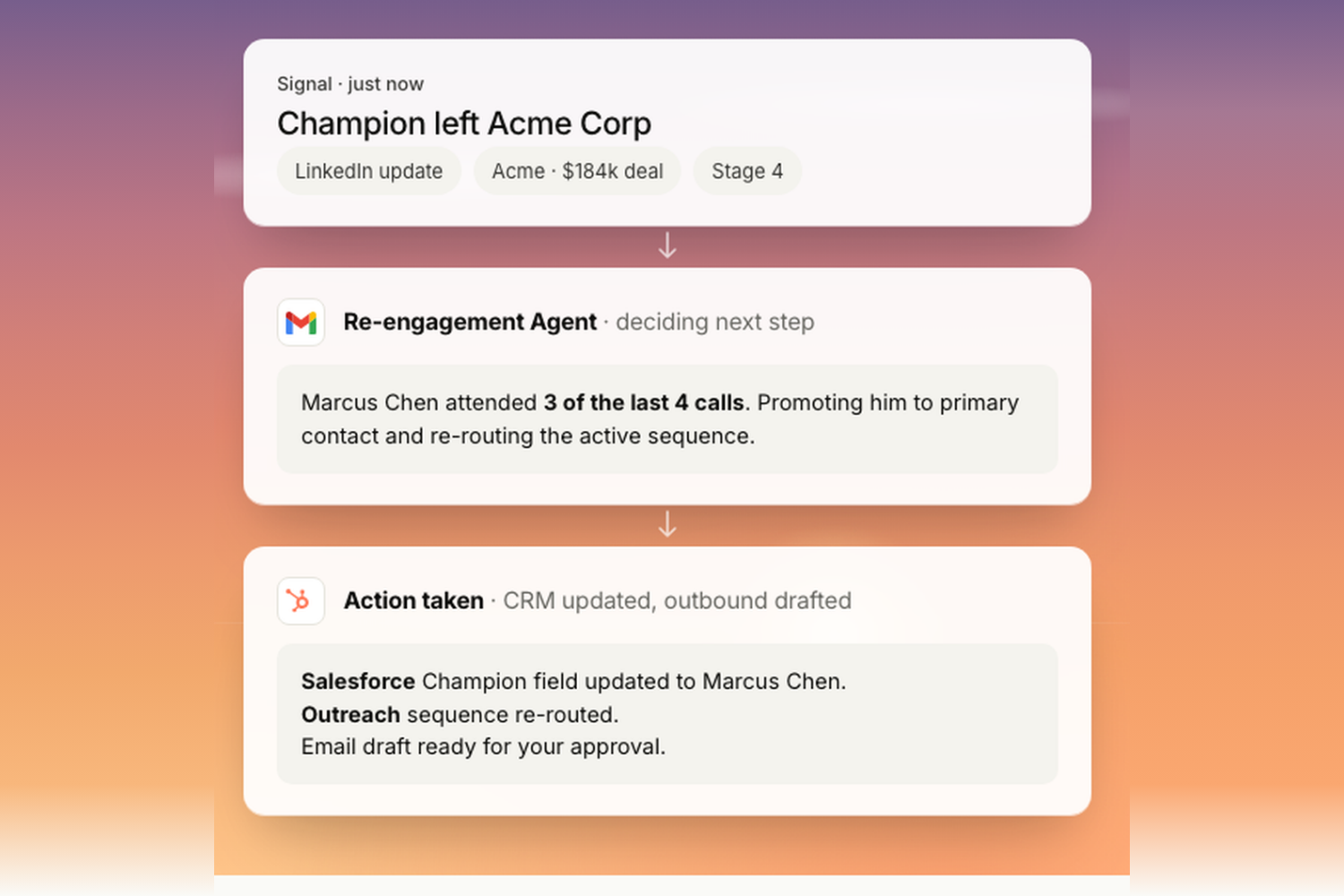
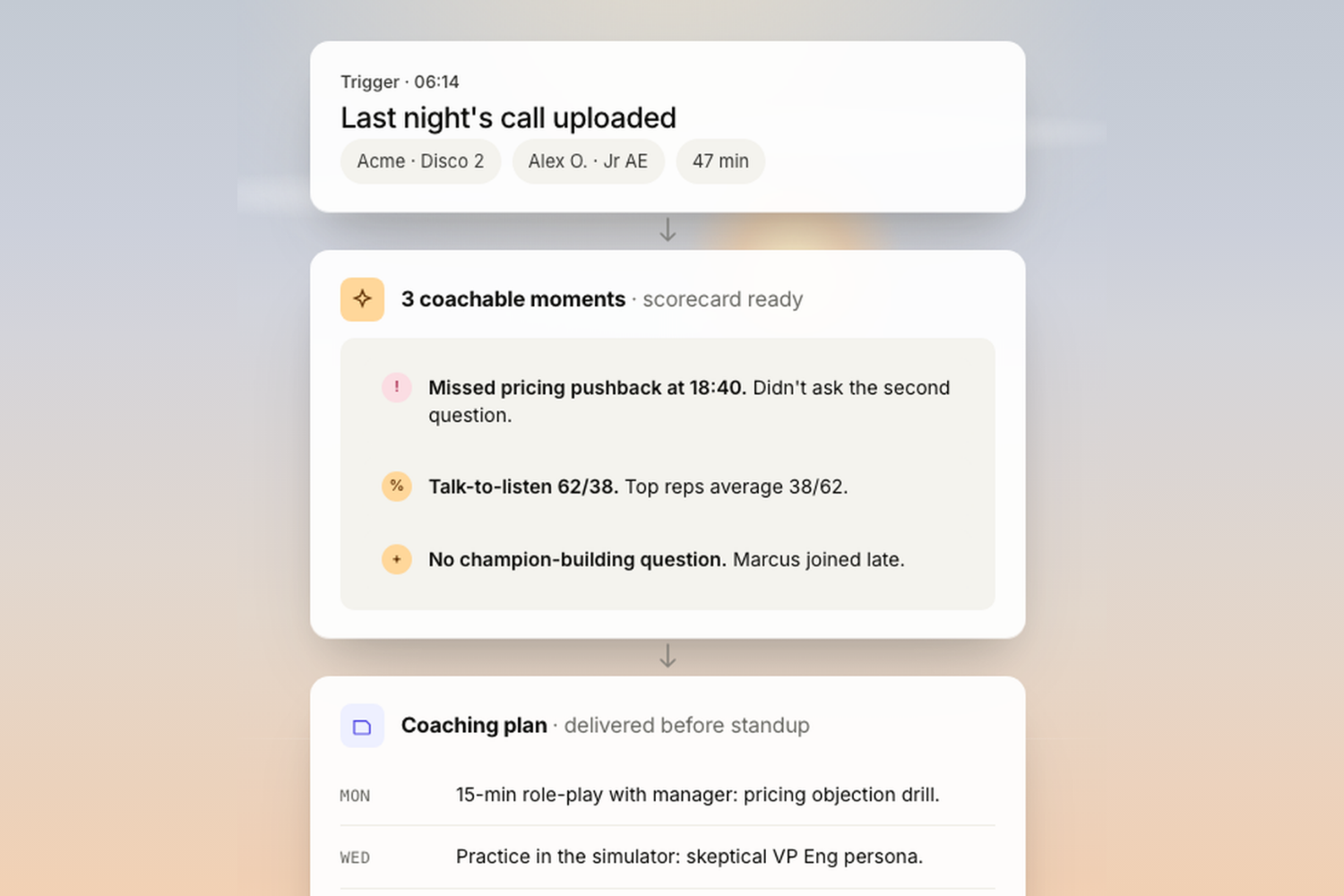
  • AI agents act autonomously across the workflow - drafting follow-ups, prepping calls overnight, monitoring pipeline health and CRM hygiene
  • Multi-LLM AI (Claude/GPT/Gemini) plus an 'Ask Airspeed' natural-language layer over all customer conversations

Cons

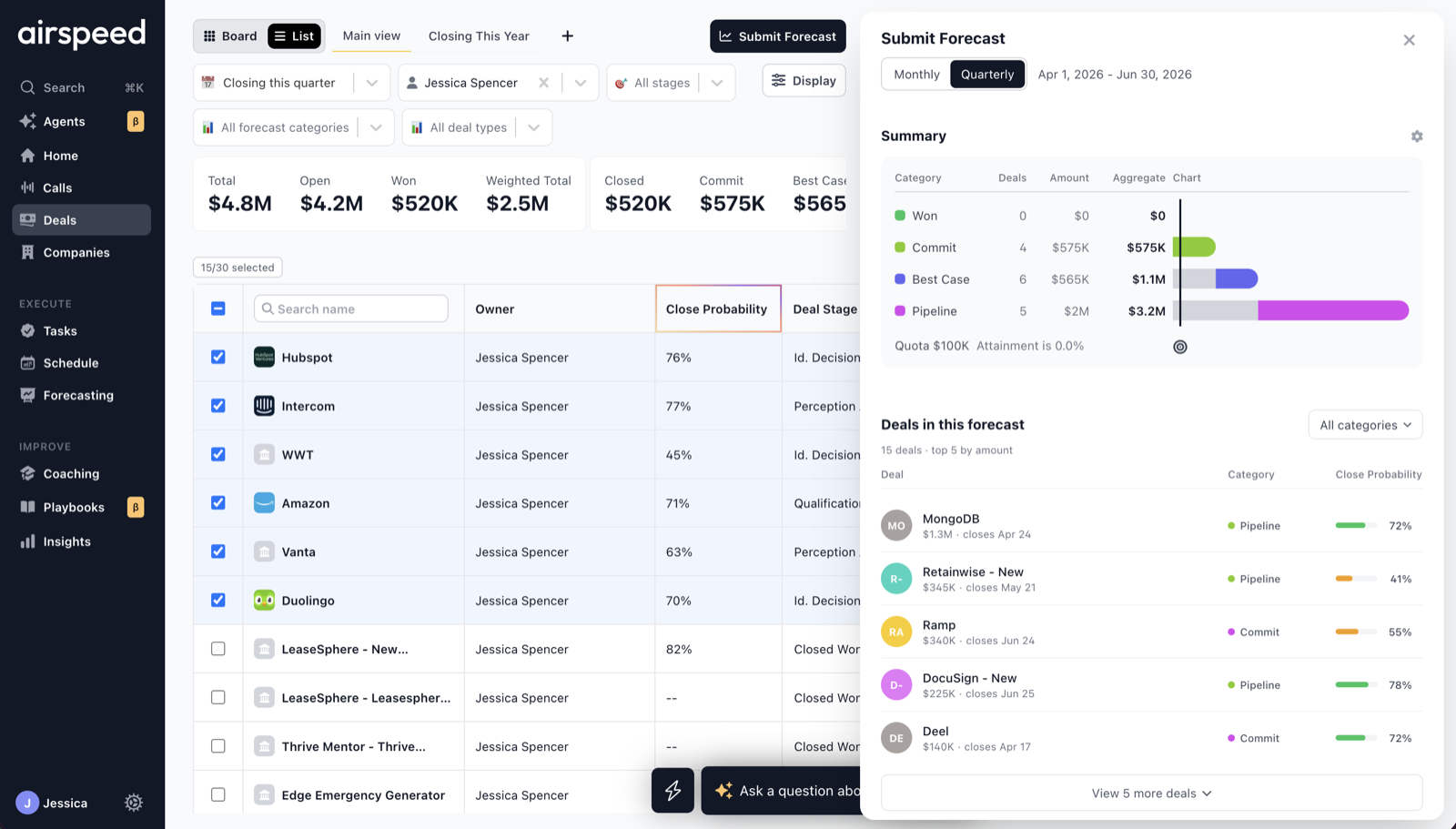
  • No full standalone forecasting suite - improves forecast inputs via structured deal data but lacks dedicated predictive revenue modeling and forecast dashboards
  • Smaller, newer brand than Gong, with less market presence and a shorter enterprise track record (rebranded from Glyphic in May 2026)
  • Sales-led pricing with no public per-seat figures; entry cost skews higher than lightweight note-takers
  • Some newer capabilities like coaching insights are still maturing
Book a Demo

7 Best Alternatives Compared

Each platform reviewed on price, features, and fit for modern revenue teams.

Pricing reflects publicly listed rates as of June 2026. List prices change often - verify current pricing with each vendor.

Gong

Revenue intelligence platform that captures and analyzes every customer interaction to drive forecasting, deal health, and coaching.

PriceContact for pricing. Third-party estimates (June 2026): Foundation roughly $1,300-$1,600/user/year; a bundled Core+Engage+Forecast suite around $2,880-$3,000/user/year, plus a platform fee commonly cited at ~$5,000/year (up to ~$50,000 for large orgs).
Best ForMid-market and enterprise sales orgs (roughly 20-50+ reps) with dedicated RevOps that prioritize behavior-based forecasting, deal-risk inspection, and data-driven coaching. Hard to justify under ~10 reps due to the platform fee.

Pros

  • Deepest conversation intelligence on the market: automatic recording, high-accuracy transcription, talk-ratio, sentiment, and AI-surfaced moments
  • Deal scoring grounded in real activity rather than rep optimism - Deal Likelihood pulls from hundreds of signals to flag at-risk deals early
  • Turns coaching from subjective to data-driven; custom Trackers surface team-wide patterns across all transcripts
  • Strong, free-to-connect integrations (Salesforce, HubSpot, dialers, Slack) with two-way CRM sync
  • Rapidly expanding 2025-2026 AI feature set: Ask Anything, Call Spotlight, and agents that auto-summarize and log to CRM

Cons

  • Expensive and opaque: no public pricing and a three-part bill (per-user + platform fee + onboarding); cost is the single most common G2 complaint
  • No real-time in-call guidance; intelligence and coaching are post-call
  • Steep onboarding (typically 3-4 weeks) requiring dedicated RevOps resources; the data-dense UI can overwhelm new users
  • Insight quality is only as good as CRM hygiene - poor logging degrades deal intelligence and forecasts
  • No free trial, annual commitments, and very short calls (under ~60 seconds) are not captured

Clari

Enterprise revenue platform that unifies forecasting, pipeline inspection, and AI deal intelligence (RevAI).

PriceNo public list pricing; sold direct. Third-party estimates (June 2026): core platform ~$100-120/user/month billed annually; with add-ons like Copilot (~$60-110/user/mo), all-in cost reaches $400+/user/month. Enterprise deployments typically north of $100K/year, with implementation adding 30-60%.
Best ForLarger enterprise orgs (~50+ reps) with a dedicated RevOps function and a six-figure budget that need best-in-class forecasting and pipeline rigor. Overkill for small, fast-moving teams.

Pros

  • Forecasting accuracy is the standout strength; reviewers commonly report a 20-30% forecast-accuracy improvement after full adoption
  • Strong pipeline inspection and revenue-leak detection across CRM, email, calendar, and call data in one RevDB
  • Mature enterprise feature set with multiple AI agents (Opportunity Scores, Deal Inspection, Ask Clari) for risk flagging and next steps
  • Seamless Salesforce integration that auto-syncs and reduces manual CRM hygiene
  • Combined Clari + Salesloft entity now spans prospecting through close, plus Copilot conversation intelligence

Cons

  • Heavy RevOps maintenance tax; reviewers report mid-size deployments consuming 10-15 hours/week of admin time
  • Steep learning curve and complex setup; full deployment runs 6-8 weeks
  • UI/UX is frequently called unintuitive and clunky; admin experience is a recurring complaint
  • Expensive and opaque pricing that escalates fast via add-on modules plus implementation fees
  • Poor fit for SMBs and fast-moving startups without dedicated RevOps

Aviso

End-to-end AI revenue platform unifying forecasting, deal/pipeline intelligence, conversation intelligence, and agentic RevOps automation.

PriceContact for pricing (custom, enterprise annual contracts). Third-party aggregators cite an estimated baseline around $50,000/year; Aviso publishes no per-seat list price (June 2026).
Best ForMid-market and enterprise revenue teams with complex, multi-region sales motions that want forecasting, pipeline inspection, and deal intelligence in one platform rather than point tools.

Pros

  • Strong, data-driven forecasting that reviewers credit for more accurate forecast calls; markets 98%+ accuracy via its AI WinScore model
  • Powerful pipeline and deal drill-downs with multi-hierarchy rollups, easier than native Salesforce dashboards
  • Broad single-platform scope (forecasting, deal/pipeline intelligence, conversation intelligence, coaching, agentic AI) reduces tool sprawl
  • Salesforce integration enables mass opportunity updates and reduces manual CRM entry
  • Responsive, hands-on customer support and implementation help

Cons

  • CRM sync is a recurring pain point: delayed or inconsistent Salesforce syncing and occasional data mismatches
  • Performance complaints, including slow-loading pages and lag during heavy quarter-end periods
  • UI can feel cluttered when navigating between many dashboards and modules
  • Limited flexibility for fully custom reports/dashboards without workarounds
  • Opaque, enterprise-only pricing; likely overkill for SMBs

BoostUp (now Terret)

AI revenue intelligence and forecasting platform (rebranded to Terret in 2025) unifying deal/pipeline data, machine forecasting, and conversation intelligence.

PriceContact for pricing. No official public price list; third-party listings commonly cite a starting point of ~$79/user/month, but mid-market and enterprise buyers negotiate custom annual contracts (June 2026).
Best ForMid-market and enterprise B2B SaaS revenue teams on Salesforce that want accurate machine forecasting, granular deal/pipeline risk scoring, and self-service revenue analytics (RevBI). Less suited to small teams on a tight budget.

Pros

  • Strong, accurate machine forecasting and pipeline visibility - leaders trust the numbers and can explain pipeline changes
  • Granular deal and engagement risk scoring built on captured activity signals, surfacing at-risk deals leaders would miss
  • Flexible RevBI self-service analytics lets RevOps build custom metrics without a central data team
  • Single pane of glass that AEs and managers prefer over living in Salesforce
  • Reviewers praise responsive support and relatively quick implementation

Cons

  • Feature breadth creates a real learning curve; the UI/navigation can feel complex or overwhelming
  • Salesforce sync is not always real-time; some reviewers report sync delays of 24+ hours
  • Certain fields can't be edited in-tool and some admin controls are limited, requiring workarounds
  • Pricing skews high for small teams, with a sales-led quote process and no transparent public pricing
  • Heavy 2025 pivot to AI agents and a rebrand to 'Terret' mean scope and brand are in flux - confirm what is GA

Salesforce Revenue Intelligence

Native, Einstein-AI-powered deal intelligence and forecasting baked directly into Salesforce Sales Cloud.

PriceSold as a Sales Cloud add-on at roughly $220/user/month (billed annually), on top of an Enterprise or Unlimited edition license. Pipeline Inspection alone is included in Enterprise+ editions. Varies by edition/contract (June 2026).
Best ForMid-market to enterprise orgs already standardized on Salesforce Sales Cloud that want AI deal scoring, forecasting, and pipeline analytics without a third-party tool, and that have admin/RevOps resources to maintain it.

Pros

  • Fully native to Salesforce: data, deal scores, and forecasts live in the same CRM reps already use - nothing to sync
  • Pipeline Inspection with waterfall and deal-flow charts gives managers real-time visibility into movement, at-risk deals, and forecast changes
  • Einstein deal scoring and Close Date predictions are trained on your own historical CRM data, not generic benchmarks
  • Bundles Einstein Conversation Insights, so call analysis is part of the same platform
  • Backed by the broader Salesforce/Agentforce ecosystem with enterprise-grade governance and scale

Cons

  • High total cost of ownership: a premium add-on (~$220/user/mo) on top of already-pricey Enterprise/Unlimited licenses
  • Steep learning curve and complex setup; often needs a dedicated admin and significant data cleansing before delivering value
  • Full value can pull in additional paid components (CRM Analytics, Data Cloud, Einstein/Agentforce credits)
  • AI forecasting depth draws mixed reviews versus specialized revenue-AI tools like Clari and Gong
  • Only practical if you are already all-in on Salesforce

People.ai (now Backstory)

Automatically captures all sales activity and tells revenue teams which deals are at risk, why, and what to do next.

PriceContact for pricing - no public list price. Third-party aggregators estimate roughly $50-$100/user/month with a median annual contract around $23,100, but these are not official figures (June 2026).
Best ForMid-market and enterprise revenue teams (sweet spot ~50+ reps) on Salesforce or other major CRMs that want hands-off activity capture and AI deal-risk/forecast intelligence rather than manual rep updates.

Pros

  • Best-in-class automatic activity capture - auto-logs emails, meetings, calls, and chat across Gmail/Outlook, Zoom/Teams, and Slack
  • Deep, proprietary multi-year activity dataset feeds deal-health scoring, risk alerts, and stakeholder/relationship mapping
  • Gives managers and reps real visibility into deals and accounts without chasing reps for updates
  • Forecasting and pipeline inspection grounded in observed engagement data, plus multi-CRM support (Salesforce, Dynamics, Oracle)
  • 2026 Backstory rebrand adds methodology-aware AI agents and open API/MCP delivery into existing CRM and agent workflows

Cons

  • Not transparently priced and skews expensive/enterprise; total cost can reach six figures, making ROI hard to evaluate up front
  • Occasional Salesforce sync issues and lag when bulk-updating many records
  • Implementation and full value require meaningful setup, data hygiene, and CRM adoption
  • Not a native call-recorder/conversation-intelligence product - it matches activity but lacks Gong-level recording and coaching depth
  • Heavily anchored to the Salesforce/enterprise ecosystem; the recent rebrand adds some roadmap uncertainty

Feature-by-Feature Comparison

How each platform stacks up on the features that matter most.

Feature Airspeed Top Pick Gong Clari Aviso BoostUp (now Terret) Salesforce Revenue Intelligence People.ai (now Backstory)
Deal Scoring & Risk
Forecasting Partial - improves inputs
Pipeline Inspection
Call Recording / CI Add-on (Copilot) Bundled (Einstein) Captures, not native
CRM Auto-Sync Salesforce + HubSpot, field-level Salesforce Salesforce Native
AI Agents / Automation Data Extractor, Researcher RevAI agents MIKI + 30 workflows Revenue agent fleet Einstein + Agentforce

Frequently Asked Questions

What is a deal intelligence platform?

A deal intelligence platform is sales software that automatically captures and analyzes the activity inside each active opportunity - calls, emails, meetings, calendar invites, and CRM updates - to assign a deal-health or win-probability score, flag risks, and roll those signals into pipeline and forecast health. Instead of trusting a rep-entered stage or gut-feel commit, it tracks leading indicators like engagement velocity, single-threading, stakeholder ghosting, missed meetings, and qualification gaps, often surfacing at-risk deals weeks before a manual review would.

How much does deal intelligence software cost?

Pricing is almost always per user per month and total cost depends on architecture. Mid-market tools run roughly $50-$150 per user per month; enterprise platforms run about $1,000-$1,500 per user per year (often $75-$250 per user per month) and frequently add a $5,000-$50,000 platform fee. Bundled enterprise stacks for around 100 users can reach several hundred thousand dollars annually, while modular no-platform-fee tools start near $19-$20 per user per month. Most enterprise vendors (Clari, Aviso, BoostUp/Terret, People.ai/Backstory) quote via demo, so compare three-year total cost of ownership rather than sticker price.

What is the difference between deal intelligence and revenue intelligence?

Revenue intelligence is the broad umbrella aggregating data across the whole go-to-market motion - pipeline, forecast, attribution, account health, and rep performance - to answer whether the team will hit the number. Deal intelligence is the opportunity-level core inside that umbrella: it scores the health and risk of each specific deal. Deal intelligence is what makes a revenue-intelligence forecast trustworthy, deal by deal. They increasingly overlap because revenue suites embed deal scoring, but the deal-intelligence lens stays on individual opportunities rather than the whole revenue picture.

How is deal intelligence different from conversation intelligence?

Conversation intelligence operates at the call level: it records, transcribes, and analyzes individual meetings for coaching and buyer signals, answering what happened on the call and how the rep can improve. Deal intelligence operates at the opportunity level and treats conversation data as one input, combining call signals with email, calendar, and CRM activity to score whether the whole deal will close and what is putting it at risk. Conversation intelligence makes reps better on the next call, while deal intelligence tells leaders which deals to worry about and why.

What is the best deal intelligence platform for mid-market teams?

Mid-market teams of roughly 30 to 200 AEs want deal scoring and AI-generated forecasting without enterprise pricing, long implementations, or heavy RevOps overhead. Airspeed is our pick for this segment because it pairs framework-aware deal scoring and risk alerts with autonomous CRM action and field-level Salesforce/HubSpot sync, so insights drive next steps rather than just populating a dashboard. BoostUp (now Terret) is another accessible purpose-built option, HubSpot-native teams often get sufficient embedded intelligence from HubSpot, and Gong Forecast works for teams already on Gong. The right pick depends on your CRM, deal-cycle length, and whether you need action or just risk surfacing.

Can a deal intelligence platform replace my forecasting tools and CRM?

It can replace or upgrade standalone forecasting, but not the CRM. Deal intelligence platforms sit on top of the CRM as an analytical layer: they read opportunity and contact data from Salesforce or HubSpot and write activity back, while the CRM stays the system of record. For forecasting, modern deal intelligence often does replace spreadsheet roll-ups and rep-entered commits because bottom-up behavioral forecasting removes submission bias and lifts accuracy. Platforms like Clari, Aviso, BoostUp/Terret, and Gong Forecast bundle deal scoring and forecasting, so they consolidate a separate forecasting tool but complement rather than replace the CRM.

See how Airspeed works in your workflow

Join revenue teams at Foleon, Qdrant, and PriceFX who automated their sales execution with Airspeed.