
Every revenue team on earth is drowning in signals right now. Intent data, call transcripts, engagement scores, product usage, the works. The problem was never getting the insight. The problem is that the insight still lands on a person at 6pm on a Thursday, and half the time that person is too buried to act on it.
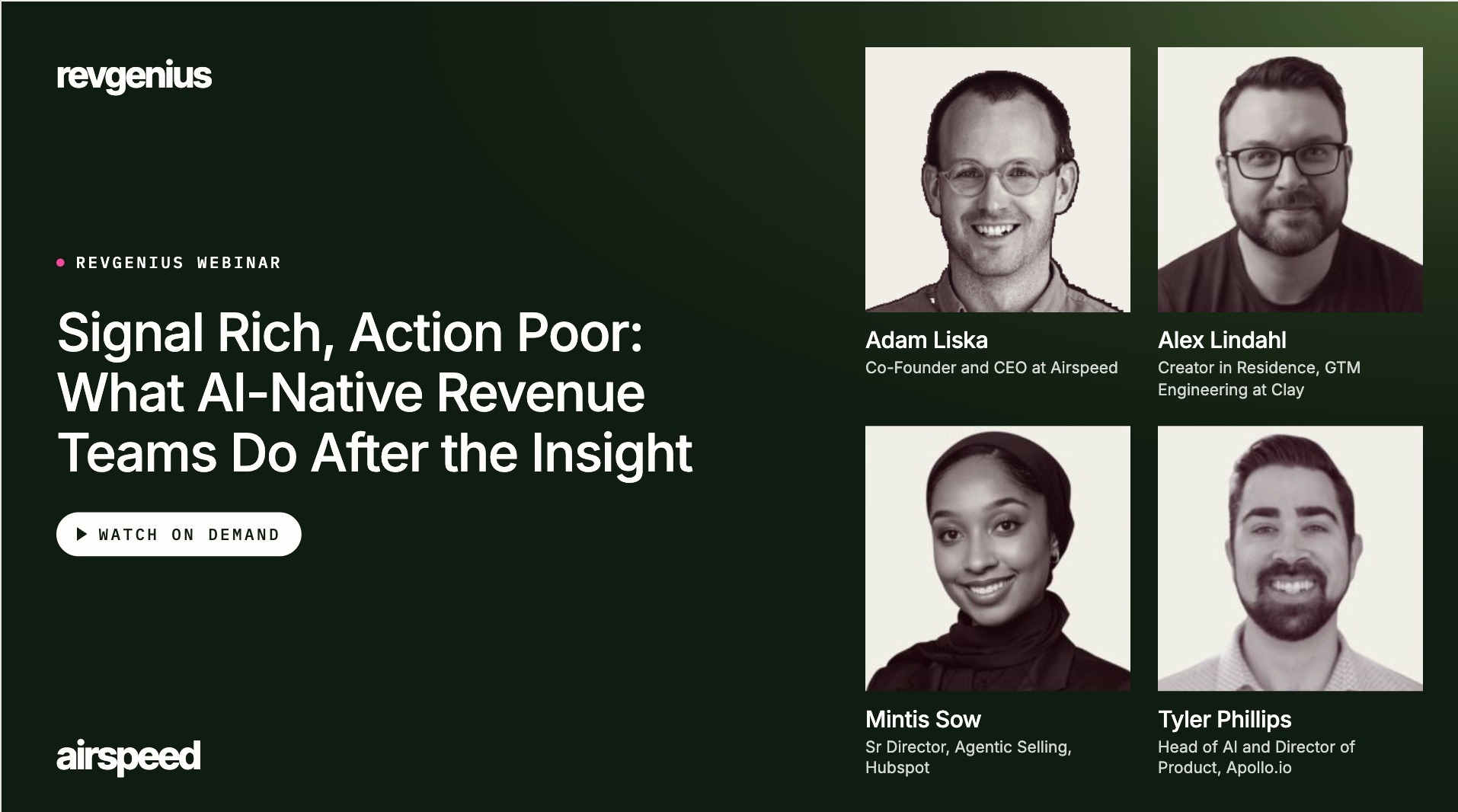
That was the premise of a recent RevGenius panel, presented by Airspeed, with four people who spend their days closer to this than almost anyone: Adam Liska (co-founder and CEO, Airspeed), Alex Lindahl (Creator in Residence, GTM Engineering, Clay), Mintis Sow (Senior Director of Agentic Selling, HubSpot), and Tyler Phillips (Head of AI and Director of Product, Apollo).
They disagreed on plenty. But the disagreements were the good part, because they exposed the questions every revenue leader is quietly wrestling with. Here are the five that mattered most.
1. Stop thinking in three separate systems
The tidy version of the modern stack goes: system of record (your CRM), system of intelligence (your AI), system of action (the thing that actually does the work). Clean model. Everyone nodded at it. Then everyone spent the next ten minutes complaining about it.
Mintis’s issue was that “system of record” makes the CRM sound passive, like a warehouse. It shouldn’t be. It should be an active participant. Alex went further and pointed out that the intelligence layer is really three things stacked together: the AI itself, a context layer that pulls everything into one place, and a learning loop that feeds outcomes back in. Most teams, he argued, bolt AI onto everything they do and then discover their context layer was never built, so the outputs are mediocre and nobody trusts them.
Tyler took the sharpest line of all: you don’t really have three systems, you have one, and pretending otherwise is the mistake.
“You technically need it to be one system to be learning over time. What people miss-file is that they have these three systems that don’t talk to each other.”
Tyler Phillips, Head of AI and Director of Product, Apollo
The nuance worth keeping: this is not an argument that you buy one product. It’s an argument about architecture. Your record, your intelligence, and your action can live in different tools, or in Claude, or behind a bespoke set of APIs. What can’t happen is the loop being broken between them. If your action layer isn’t connected back to your intelligence layer, you don’t have a learning system. You have three expensive silos.
Adam’s read on where this goes: the layers will blend. Right now it genuinely feels like you need three or four separate parts. In twelve months, he thinks, you won’t. The roadmap of nearly every serious product points at the same convergence.
2. The handoff is where everything breaks
Ask where AI-native selling actually falls over, and nobody said “the model isn’t smart enough.” They said: the handoff.
There are two kinds, and Mintis was firm that they deserve different levels of caution. A task handoff, where AI passes work to a human internally, can be aggressive. A customer handoff, where an AI-drafted thing reaches an actual buyer, is your highest-risk action and should be managed conservatively. Sensible.
But the handoff she’s most preoccupied with is the invisible one, the one between your systems and your own brain:
“Do you actually read every word your prompt gives you back? No. You skim for the answer and move on. You probably only absorb 40% if you’re lucky. That’s a handoff drop-off.”
Mintis Sow, Senior Director of Agentic Selling, HubSpot
That is the quiet killer. Your tools can surface a perfect insight and it still evaporates, because the human it was handed to never truly absorbed it. Which is exactly why “more data” is not the win everyone assumed it would be.
Alex has lived this at Clay. They piped every workflow signal into Slack, customer signals, lead alerts, follow-ups to approve, all of it. And then the volume became noise, the team stopped reading any of it, and the whole thing quietly died. Signal fatigue. The job of AI now, he and Adam agreed, is not to add more. It’s to reduce the noise and surface only the small number of next best actions a rep can realistically take.
Two design principles fell out of this section, and they’re worth writing on a wall somewhere:
First, go to where people already work, not where you wish they worked. As Tyler put it, some reps want a micro-app, some want to live in Claude, some want it in Slack, almost nobody wants to open the CRM to do it. Building “headlessly” and meeting people in their own environment is what lowers friction enough to get adoption at all.
Second, give reps a say. If the people using the system can’t shape it and improve it, they’ll never trust it, and they’ll ignore it. Trust is a feature, not a vibe.
3. Where does the work actually live?
This was the fight. And it was a good one.
Tyler’s position was blunt: the CRM was built for a world where humans typed information in so managers could see what reps were doing. It was not built for an AI-native world. He’d rather see the source of truth sit somewhere flexible, a data warehouse, something like Snowflake, where the data is available to whatever interface a person wants to work in. People, he argued, gravitate to AI assistants because that’s where it feels like anything is possible, and that’s not the CRM.
Mintis didn’t fully disagree, but she drew a line most product-first takes skip right over: it depends enormously on who your sellers are.
“Some of your most tenured sellers are really good at selling and they are not used to this. Enterprise sellers grew up with one curated system. You can’t have 2,500 reps talking to five agents. It won’t work.”
Mintis Sow, Senior Director of Agentic Selling, HubSpot
An AI-native company like Clay has a different DNA. Their sellers are half builder, half closer, and they’ll happily assemble their own tools. A large enterprise with thousands of tenured reps is a completely different animal, and the honest answer for them might be that the structured data still needs to land in one familiar place while the fancy stuff happens elsewhere.
Adam offered the bridge that made everyone comfortable: look at software engineering, which is a year or two ahead of go-to-market on all of this. Engineers don’t type code one letter at a time in their IDE any more. They work at a high level in Cursor, in Claude, in whatever suits them. But it all still lands in the code base, the shared thing the whole company builds around. Maybe the CRM, or a data layer, is simply the code base of revenue. People work wherever makes them fastest. The truth still has to come home somewhere.
4. Trust is earned, and mostly it’s a human problem
Here’s the line that should reassure anyone nervous about handing work to agents. Mintis, running this at HubSpot scale, said that nearly every real mistake she can point to in the last six to nine months started with a human.
“It’s very obedient. When it goes wrong, it’s usually between the chair and the desk. The criteria was wrong, the instructions were wrong, the setup was wrong.”
Mintis Sow, Senior Director of Agentic Selling, HubSpot
The technology follows directions. We’re just still learning to give good ones.
So how do you decide what runs autonomously versus what waits for a human? The panel split, productively.
Alex is deliberately keeping a human in the loop on outbound, not because AI can’t draft it, but because the review step is where the learning happens. Every edit a rep makes is a signal that aligns the system to that rep’s taste. Tyler framed the same idea more strongly: for anything non-deterministic, anything that’s a “taste call” with no single right answer, you need that loop enough times to trust it. His deeper principle is the one worth stealing:
“AI should only be used autonomously when it can check its own work. Coding succeeded because you can run the code and confirm it works. If there’s no way to verify, it’s very hard to let it run unattended.”
Tyler Phillips, Head of AI and Director of Product, Apollo
Give the AI a metric to optimize against, like reply rate on a sequence, and it will experiment and genuinely improve. Take that scoreboard away and you’re just hoping.
Adam pushed the other direction, and this is the tension every leader has to resolve for themselves. We are, he argued, too conservative. A mid-market rep obsesses over their top five deals and quietly drops the bottom 80%, where follow-ups simply never happen at all. An AI that re-engages a deal you’d written off, even imperfectly, at 98%, beats you doing it at 6pm or not doing it whatsoever.
“It’s going to send an OK email. If it makes a mistake, that’s fine, we make mistakes too. But if it re-engages a deal I thought was dead, it’s worth it.”
Adam Liska, Co-founder and CEO, Airspeed
Both things are true. Verify what you can measure, keep a human on what’s pure taste, and be honest that the cost of inaction is real. The deals that never get worked are a cost too, they’re just invisible on the P&L.
5. The real edge is a system that gets better
If there was one takeaway to carry into a vendor conversation, Tyler handed it over gift-wrapped. Ask any tool you’re evaluating a single question:
“Show me a customer who used it for a year where the product got measurably better. If it didn’t, it isn’t learning over time.”
Tyler Phillips, Head of AI and Director of Product, Apollo
Raw intelligence is becoming a commodity. The durable edge is a self-learning revenue system that compounds specifically for your business, on your data, over time.
Which is why the call recording debate matters more than it sounds. The panel largely agreed that the call is where selling actually happens, and that conversation data is central. But central is not the same as sufficient. Adam’s point: you can’t build a commercial brain for your company off calls alone. The deal often really gets done over Slack, over text, in the room, in all the messy moments a recorder never captures. Mintis pushed the timeline point too. For early-stage companies, mining conversations barely matters, you’re just trying to book the meeting. For established teams working the full cycle to closed-won, conversation data becomes essential, because getting meetings and getting dollars are two very different problems.
And a closing note that every content and GTM leader should tattoo somewhere. When you decide how far to automate customer-facing work, it’s not only a capability question, it’s a brand question. Some of your buyers care deeply about not being recorded, or not being handled by a bot. Know who you’re selling to, know what risk they’re comfortable with, and match them in public even if you run harder behind the scenes. One bad look becomes the next viral LinkedIn story, and then it doesn’t matter how clever your agents are.
The through-line
Strip away the vendor logos and every one of these themes points at the same gap. We have never had more signal, and the work still isn’t getting done. The teams pulling ahead aren’t the ones with the most data or the cleverest model. They’re the ones who closed the loop between insight and action, gave reps a system they actually trust, and let it learn.
Insight without action is just waste. The interesting work in 2026 is everything that happens after the insight arrives.
Watch the full panel on demand: Signal Rich, Action Poor. If you want to see what closing that loop looks like in practice, book a demo of Airspeed.
Frequently asked questions
What does signal rich, action poor mean?
It describes a revenue team with more insight than it can act on. Intent data, call transcripts, engagement scores, and product usage all land as signals, but the work of acting on them still falls to a person who is too buried to get to it. The gap is execution, not insight.
What are the three layers of an AI-native revenue stack?
The system of record (your CRM), the system of intelligence (your AI and the context layer feeding it), and the system of action (the layer that does the work). The panel's argument was that these can live in different tools, but the loop between them has to stay closed or the system never learns.
When should an AI agent run autonomously in sales?
Tyler Phillips of Apollo's rule is that AI should run unattended only when it can check its own work. Give it a measurable target, like reply rate on a sequence, and it can experiment and improve. For taste calls with no single right answer, keep a human in the loop, because the review step is where the system learns your preferences.
How do you evaluate an AI revenue tool?
Ask the vendor to show you a customer who used it for a year where the product got measurably better. Raw model intelligence is becoming a commodity, so the durable advantage is a system that compounds on your data, for your business, over time.