
Conversation intelligence software has changed how revenue teams understand sales calls. Instead of relying on managers to review recordings by hand, AI can transcribe conversations, summarize meetings, identify topics, score calls, and surface coaching and deal signals.
But there is a problem. Conversation intelligence does not always surface the sales insights teams actually need.
A platform can accurately transcribe a 45-minute discovery call and still miss the most important thing about the deal. It might identify a pricing objection without knowing the same objection appeared in three previous calls. It might flag negative sentiment without knowing the economic buyer stopped attending meetings. It might identify a next step without knowing the rep has already missed it twice.
The problem is not that the AI cannot understand the conversation. It is that understanding a conversation is not the same as understanding a deal.
Why conversation intelligence misses sales insights
The typical conversation intelligence workflow looks like this: record, transcribe, analyze, summarize.
That workflow is useful. But revenue teams need something closer to: capture, understand, add context, update the CRM, identify risk, take action, measure the outcome.
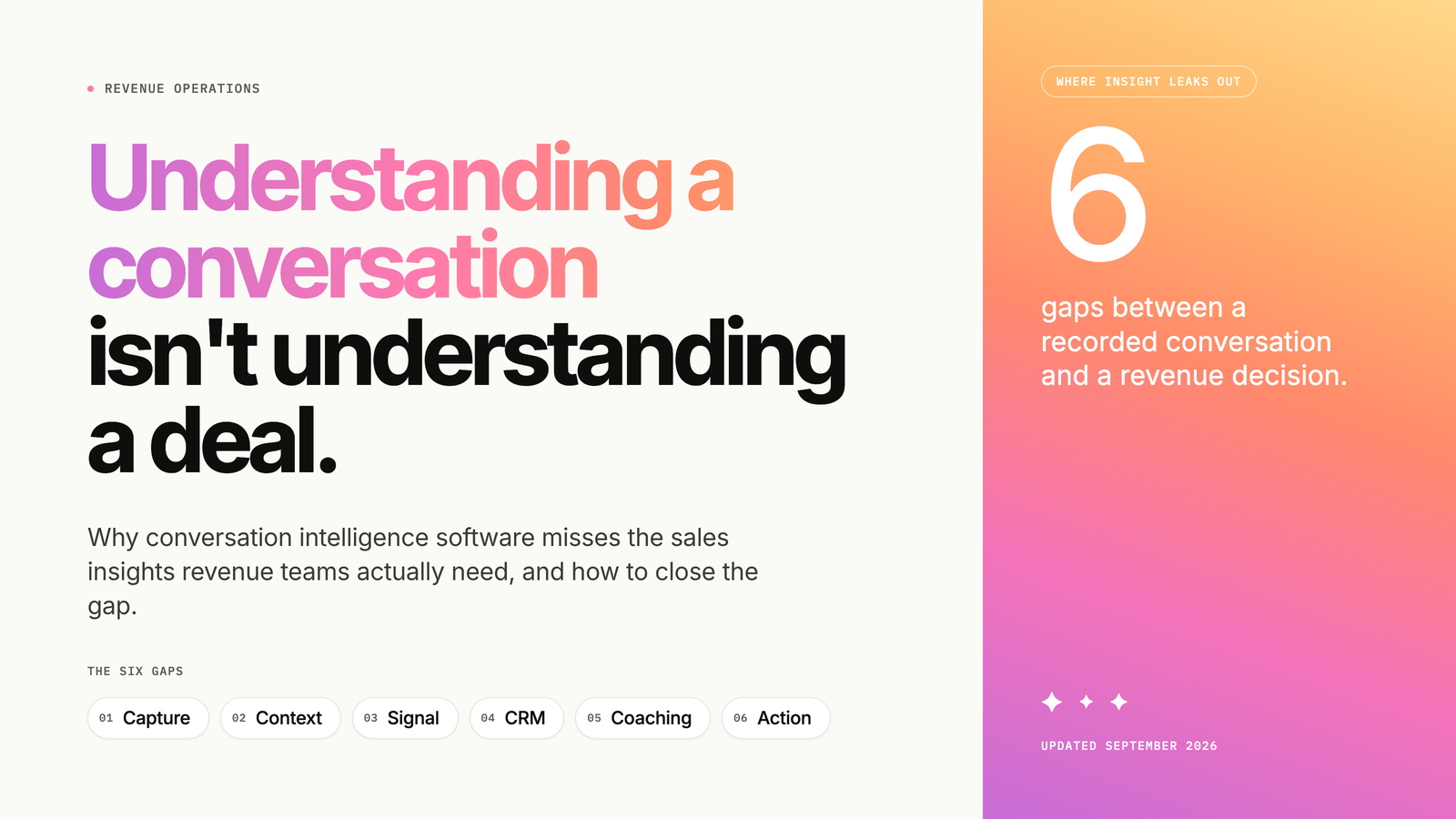
Every step creates an opportunity for information to get lost. There are six common gaps.
- The capture gap. The system cannot analyze conversations it never sees.
- The context gap. A single conversation does not tell you everything about a deal.
- The signal gap. Keywords and predefined trackers miss unexpected signals.
- The CRM gap. Insights that stay inside the conversation intelligence platform do not change the forecast.
- The coaching gap. Identifying a behavior does not change it.
- The action gap. A risk flag is worthless if nobody acts on it, and nobody checks whether they did.
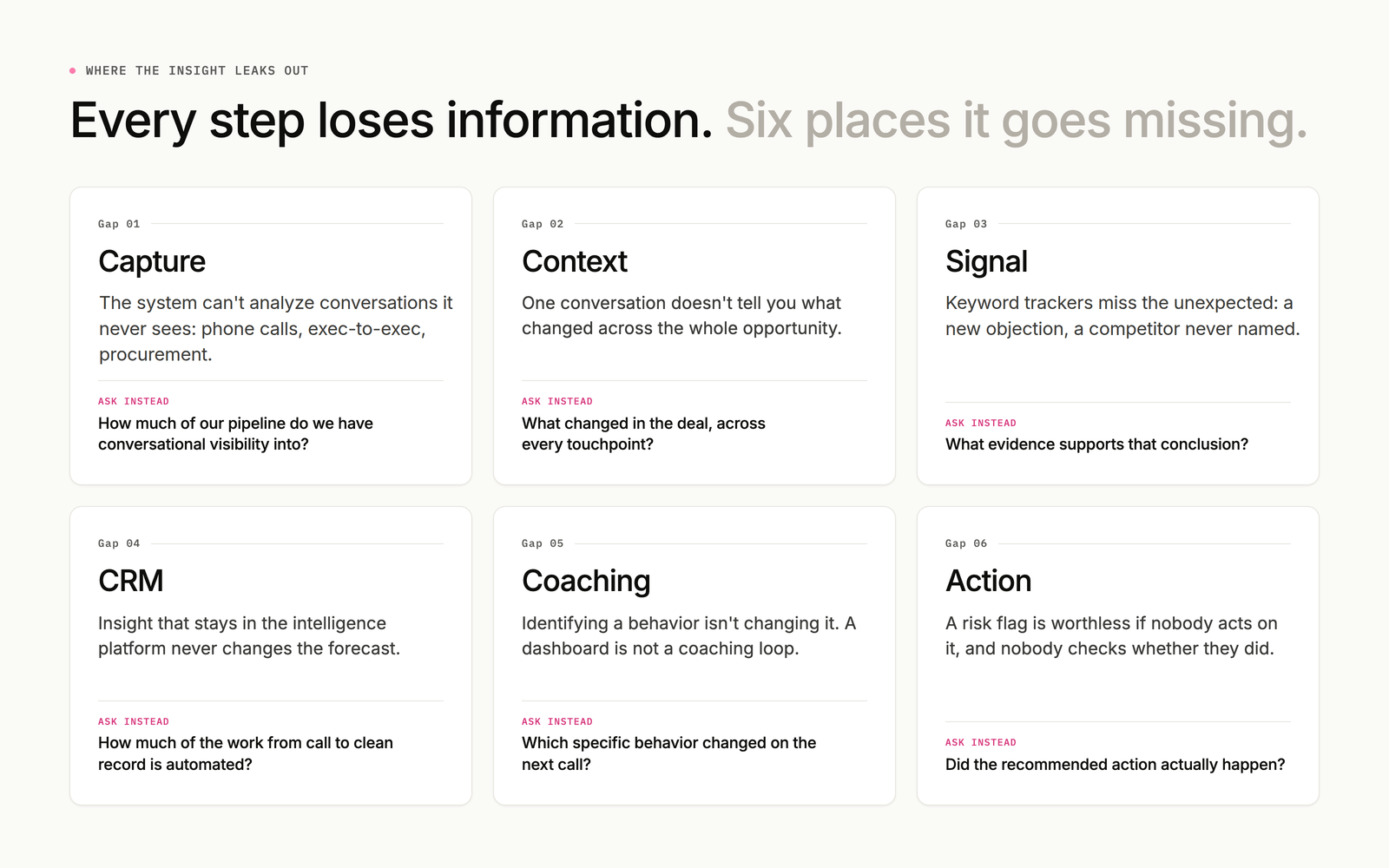
For mid-market revenue teams, these gaps create blind spots in coaching, forecasting, CRM integration, revenue team analytics, and deal risk visibility. Here is where each one comes from, and how to close it.
1. The capture gap: your AI cannot analyze conversations it never sees
Conversation intelligence is only as comprehensive as the conversations it captures. That sounds obvious, and it has real implications for pipeline visibility.
A platform may capture most of your recorded Zoom calls while missing phone conversations, meetings on unsupported platforms, calls where recording was not enabled, executive-to-executive conversations, procurement discussions, customer conversations outside the sales team, informal stakeholder chats, and conversations happening over other channels.
Conversation coverage is not pipeline coverage.
Picture an opportunity with six stakeholders. Your team has recorded four meetings with the champion. The economic buyer has a separate conversation with your CEO. Procurement has a phone call with your account executive. Neither makes it into the platform, and the system now has an incomplete picture of the deal.
How to fix the capture gap
Measure more than the number of calls recorded. Track the share of eligible conversations captured, meeting platform coverage, phone coverage, external meeting coverage, recording consent rates, and the percentage of active opportunities that have conversation data at all.
The question is not “how many calls did we record?” It is “how much of our pipeline do we actually have conversational visibility into?“
2. The context gap: a conversation is not a deal
This is one of the biggest limitations of conversation intelligence software. A call is an event. A deal is a sequence of events.
A conversation might tell you the buyer is concerned about implementation. That statement means very different things depending on the rest of the opportunity. Maybe it is the first time implementation has come up. Maybe the same objection appeared in three previous meetings. Maybe the champion already resolved it. Maybe procurement, not implementation, is the real blocker. Maybe the economic buyer has not attended a meeting in six weeks. Maybe the close date has already slipped twice.
The individual call cannot tell you any of that.
| Call-level intelligence | Deal-level intelligence |
|---|---|
| What was said? | What has changed? |
| What topics came up? | Which issues remain unresolved? |
| What objections appeared? | Have objections appeared repeatedly? |
| Was a next step mentioned? | Did the next step actually happen? |
| Was sentiment positive or negative? | Is buyer engagement changing over time? |
| Who participated? | Which stakeholders are missing? |
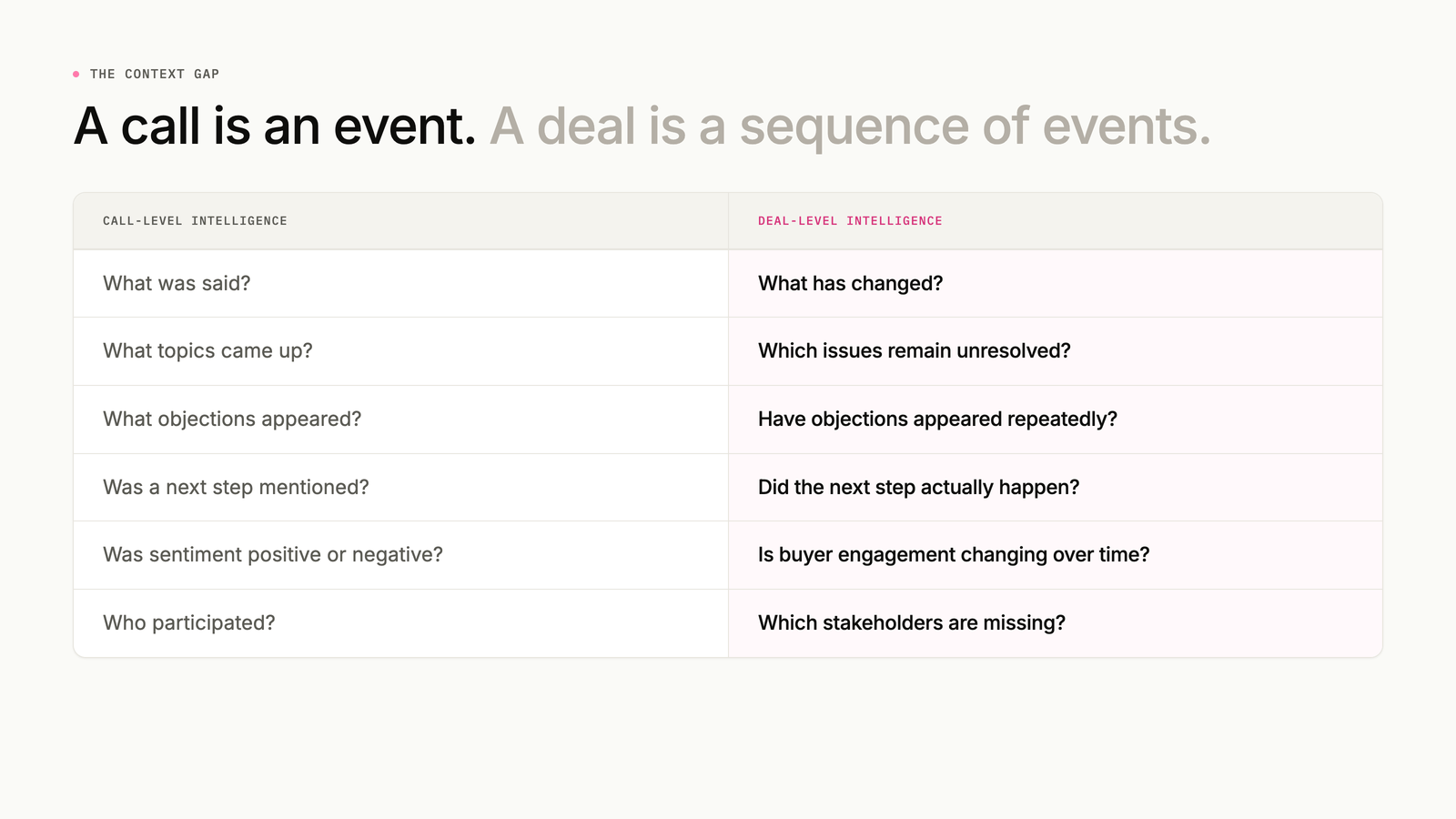
This distinction is critical for deal risk visibility. A useful deal-risk system needs more than a transcript. It needs previous conversations, CRM data, opportunity stage, close date, stakeholder activity, meeting attendance, next steps, deal history, and buyer engagement.
How to fix the context gap
Connect conversation intelligence to the opportunity and the account record. Instead of analyzing a call into an insight, build toward calls plus CRM plus account history plus stakeholder activity into deal context, and generate the insight from there.
That is the difference between knowing what happened on a call and understanding what it means for the deal.
3. The signal gap: keywords are not the same as understanding
Many conversation intelligence systems use trackers, topics, keywords, and predefined scorecards to identify important moments. Those are useful, and they create blind spots.
Imagine a sales team sets up a competitor tracker for three known competitors. During a call the buyer says: “We are evaluating another option that has a much shorter implementation timeline.” The buyer just revealed a competitive signal. If the system is only looking for specific competitor names, it may not recognize what was said.
The same problem shows up with new objections, unexpected buying criteria, changes in the decision process, new stakeholders, budget concerns, timeline changes, expansion opportunities, and churn signals.
Keywords are inputs. Context creates meaning. A stronger approach combines the conversation with the rest of the deal. “We need to push this into next quarter,” against a close date of September 30, a close date that already moved twice, and an economic buyer who skipped the last two meetings, is a deal risk signal. On its own, it is a phrase.
How to fix the signal gap
Stop asking “did the buyer mention a risk keyword?” and start asking “what changed in the deal, and what evidence supports that conclusion?”
Prioritize systems that combine conversation content, CRM data, account history, stakeholder engagement, deal stage, timeline, and previous conversations. The goal is to identify patterns, not phrases.
4. The CRM gap: an insight is not useful if it stays in another system
This is where conversation intelligence becomes a RevOps problem.
Your platform identifies that the decision criteria changed. Your CRM still says decision criteria: original requirements, stage: proposal, close date: September 30. The revenue team now has two versions of reality. The insight exists. The CRM does not.
That matters because the CRM is where revenue teams manage opportunities, run pipeline reviews, build forecasts, report revenue, manage workflows, track stakeholders, and make executive decisions.
So CRM integration needs to mean more than attaching a transcript to an opportunity. Synchronization means the recording and summary are visible in Salesforce. Automated CRM data entry means the system understood the conversation and updated the relevant fields: pain points, decision criteria, budget, timeline, decision makers, competition, qualification fields, next steps, and deal risks.
How to fix the CRM gap
Ask vendors whether the platform can update custom fields, update contacts and opportunities, create tasks, capture next steps, let reps approve updates, maintain an audit trail, let RevOps configure field-level rules, and how quickly information syncs. Then ask the one most teams skip: what happens when the conversation conflicts with existing CRM data?
The question is not “does it integrate with Salesforce?” It is “how much of the work between a customer conversation and a clean CRM record can it actually automate?“
5. The coaching gap: finding a problem is not the same as fixing it
Sales coaching is another area where conversation intelligence stops too early.
An AI system identifies that a rep talks significantly more than the buyer, does not ask enough discovery questions, skips a qualification step, does not establish clear next steps, or struggles with a specific objection. That is valuable. An insight alone does not change behavior.
A manager still needs to understand the issue, discuss it with the rep, explain the desired behavior, practice it, apply it on the next call, review the result, and reinforce or adjust.
The coaching loop therefore runs: insight, coaching, practice, next call, feedback, measurement. Not insight, dashboard.
How to fix the coaching gap
Connect conversation analysis to one specific behavior. Observation: the rep jumps into a product demonstration before understanding the buyer’s priorities. Recommendation: ask two more discovery questions before presenting the solution. Practice: role-play the first five minutes of a discovery call. Next call: apply the behavior. Measurement: compare discovery scores across the next several calls.
That creates a feedback loop instead of another report.
6. The action gap: a risk flag nobody owns changes nothing
The last gap is the one that decides whether any of the other five were worth closing.
Conversation intelligence surfaces signals that matter to forecasting: slipping next steps, missing stakeholders, repeated objections, falling buyer engagement, competitive threats, timeline changes, pricing concerns, qualification gaps, and changed decision criteria. But a signal is not a forecast, and a forecast is not a next step.
Take “we are still evaluating our options.” That might indicate risk, or it might be completely normal for the stage. To know which, you need the stage, how long the deal has been in it, who is involved, whether the buyer committed to a timeline, whether next steps are scheduled, whether the close date moved, whether the same concern appeared before, and what the CRM currently says.
So the workflow runs conversation signal, deal context, risk assessment, forecast impact, action. And then it has to close: somebody owns the action, does it, and the system checks that it happened.
How to fix the action gap
Define the end of the workflow before you buy the software. For every risk the platform raises, name the owner, the action, the deadline, and the check that confirms the action happened. Managers should be able to see the evidence behind a risk signal, because a recommendation without evidence is hard to trust and easy to ignore.
Then ask the question that separates a dashboard from an execution layer: after a risk is identified, can the platform trigger the workflow, create the follow-up task, update the CRM, and track whether the recommended action was completed?
The hidden problem: too many dashboards
There is another issue underneath all six gaps. Revenue teams have more data than they can act on: a CRM, conversation intelligence, forecasting software, sales engagement, enablement, business intelligence, product analytics, and customer success systems.
Each system produces insights. The manager still has to open each one.
The revenue team does not need more intelligence. It needs less distance between intelligence and action.
The evolution looks like this. Generation 1: record, transcribe, store. Generation 2: record, analyze, report. Generation 3: understand, add context, decide, act, measure.
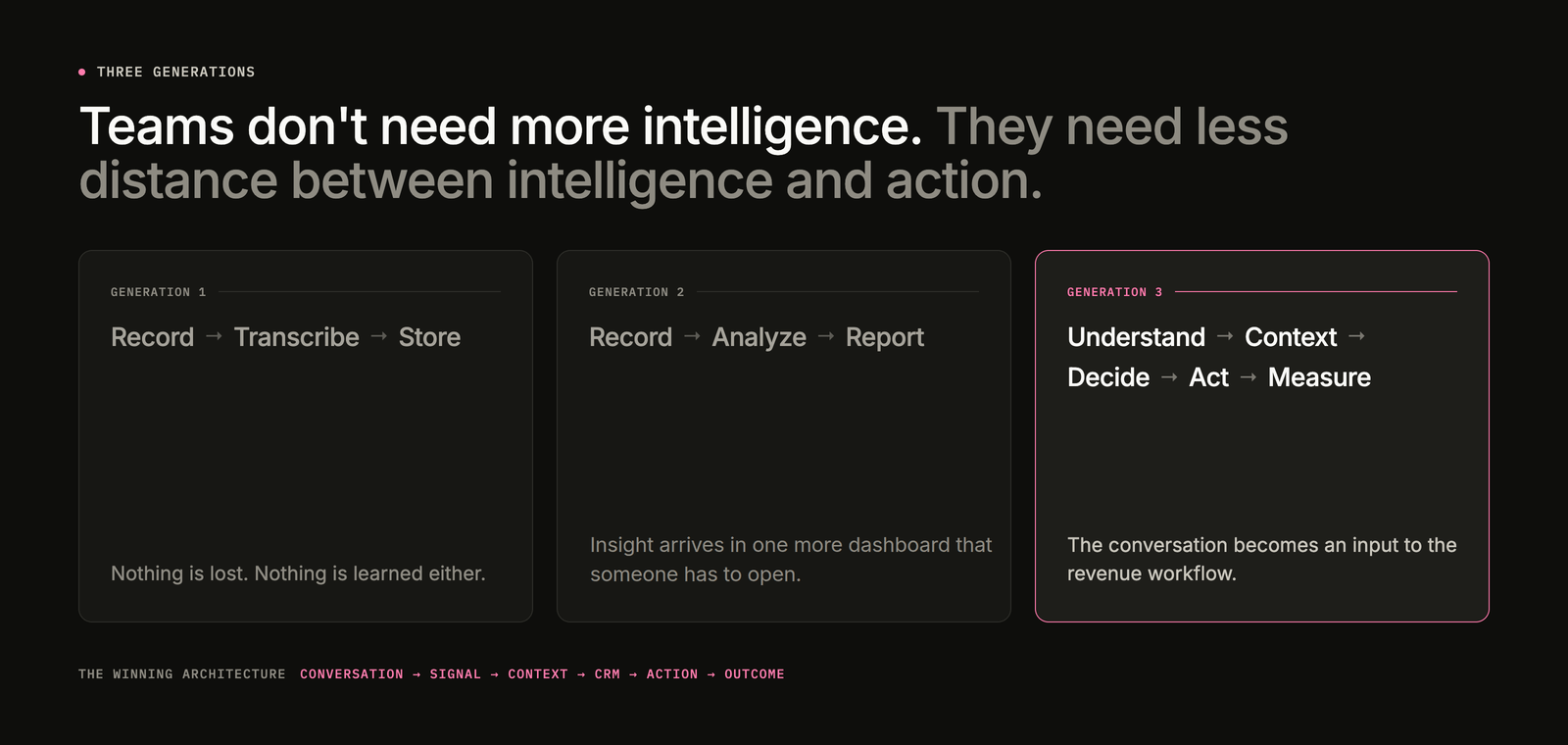
That is where the next generation of revenue AI is heading.
Conversation intelligence vs. revenue intelligence vs. revenue execution
These categories overlap, and they are not identical.
| Capability | Conversation intelligence | Revenue intelligence | Revenue execution |
|---|---|---|---|
| Record conversations | Yes | Yes | Yes |
| Transcribe calls | Yes | Yes | Yes |
| Analyze conversations | Yes | Yes | Yes |
| Identify coaching signals | Yes | Yes | Yes |
| Identify deal signals | Yes | Yes | Yes |
| Connect CRM context | Sometimes | Yes | Yes |
| Update CRM | Sometimes | Sometimes | Yes |
| Create workflows | Limited | Limited | Yes |
| Execute next steps | Rarely | Rarely | Yes |
| Measure outcomes | Limited | Yes | Yes |
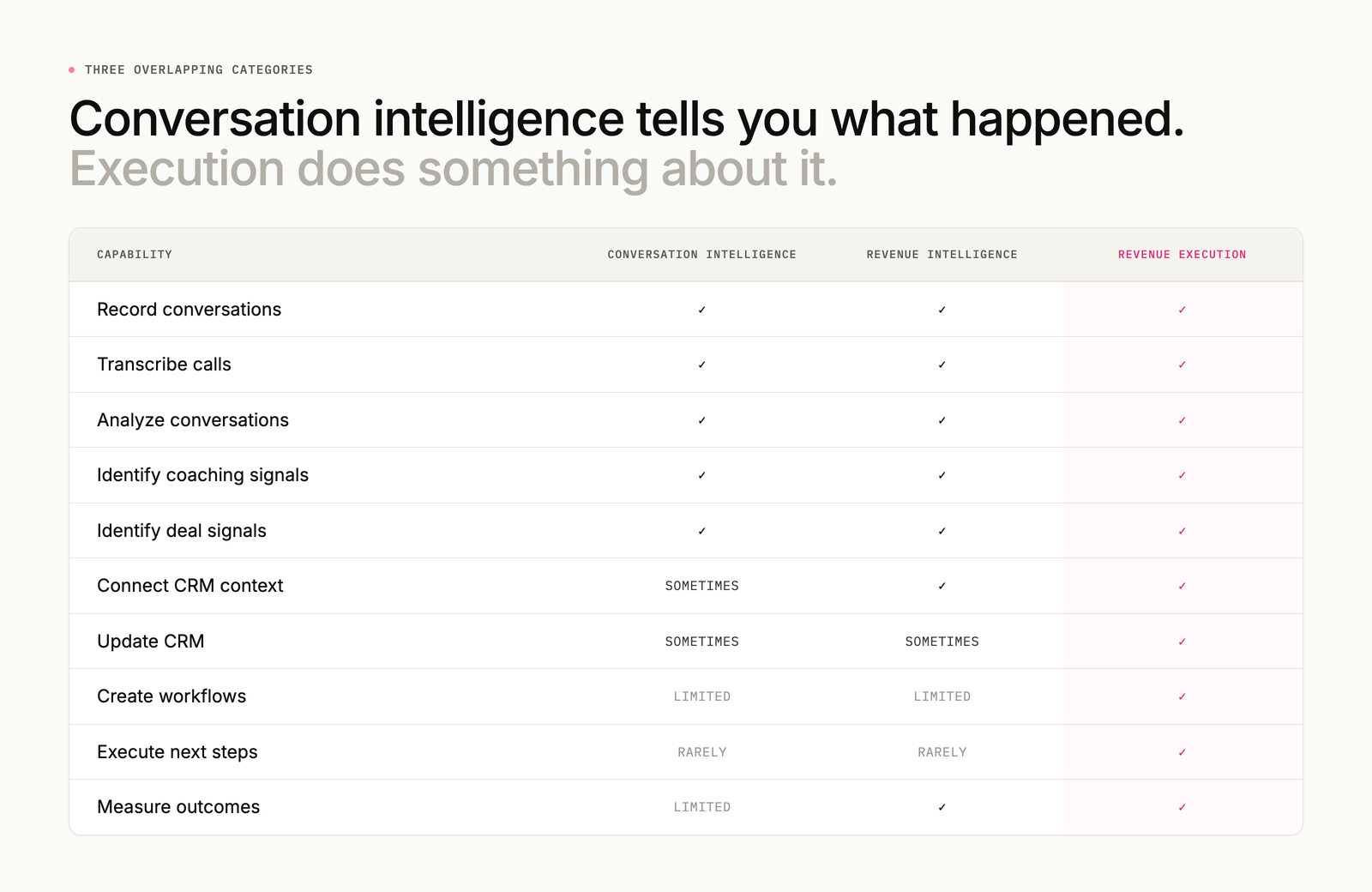
The point is not that traditional conversation intelligence stopped being useful. It is that the category is expanding, and the conversation is becoming an input into a broader revenue workflow.
How to fix the gaps in your conversation intelligence strategy
You do not necessarily need to replace your existing software. Start by evaluating the workflow around it.
Step 1: measure conversation coverage. What share of active pipeline has usable conversation data? Measure coverage across opportunities, stakeholders, and channels, not calls recorded.
Step 2: connect conversations to the CRM. Conversation signals should attach to accounts, contacts, opportunities, deal stages, qualification fields, next steps, and forecasts.
Step 3: define the signals that actually matter. Do not track everything. Identify the signals that correlate with deal progression, forecast accuracy, coaching improvement, pipeline movement, win/loss, expansion, and churn.
Step 4: automate the administrative work. Decide which conversation-driven tasks can happen without a human: conversation, CRM update, task, follow-up. Instead of: conversation, rep takes notes, rep updates CRM, rep creates task, manager checks CRM. AI agents are the practical way to run that.
Step 5: build coaching loops. Turn insights into behaviors. Define what good looks like, how it is measured, who coaches it, how reps practice it, and how improvement is tracked.
Step 6: measure business outcomes. Not “our reps are using the platform.” Track coaching sessions per rep, time from call to coaching, skill improvement, discovery quality, objection handling, ramp time, CRM field completion, CRM freshness, manual data-entry time, opportunities with documented next steps, activity logging coverage, forecast variance, forecast accuracy, slipped-deal rate, stage aging, deal cycle time, pipeline coverage, and time from risk detection to action.
The goal is to find out whether conversation intelligence is changing how the revenue organization operates, not how many calls it analyzed.
A practical framework for evaluating conversation intelligence software
When you evaluate vendors, ask questions across five areas. Our 2026 conversation intelligence buyer’s guide works through how the major platforms compare on each.
1. Capture. What conversations can the platform capture? Does it support our meeting and phone systems? What share of our pipeline will realistically be covered?
2. Intelligence. Can it identify custom topics? Can it understand patterns across multiple conversations? Can it combine conversation signals with CRM context? Can users see the evidence behind an AI-generated insight?
3. CRM integration. What objects can it update? Can it write to custom fields? Can it create tasks? Can reps approve updates? Is there an audit trail?
4. Sales coaching. Can managers create custom scorecards? Are calls scored automatically? Can the platform identify skill gaps? Can coaching outcomes be measured?
5. Action. What happens after a risk is identified? Can the platform trigger workflows? Can it create follow-up tasks? Can it update the CRM? Can it track whether the recommended action happened?
That last category is increasingly the one that matters. The value of an insight is not only whether it was accurate. It is whether it changed what happened next.
The future of conversation intelligence is action
Conversation intelligence started with a simple promise: never lose the information inside a sales call. That is still valuable.
Revenue teams now have a bigger expectation. They want to know what it means, whether it changes the deal, whether it changes the forecast, whether the rep needs coaching, whether the CRM should be updated, who needs to act, and what should happen next.
So the next evolution is not better transcription or more sophisticated summaries. It is the connection between conversation, context, and execution. The winning architecture looks less like conversation, transcript, dashboard, and more like conversation, signal, context, CRM, action, outcome.
For mid-market revenue teams that shift matters most. Smaller teams do not have endless RevOps capacity to connect insights across systems by hand. The goal is not another place to look. It is less work between customer intelligence and action.
Conversation intelligence tells you what happened. Revenue execution helps your team do something about it. To see the difference on your own pipeline, book a demo.
Frequently asked questions
How do we fix the capture gap in conversation intelligence?
Measure conversation coverage, not call volume. Track the share of eligible conversations captured, meeting platform coverage, phone coverage, external meeting coverage, recording consent rates, and the percentage of active opportunities that have any conversation data at all. The question is not how many calls you recorded. It is how much of your pipeline you have conversational visibility into.
How do we fix the context gap in conversation intelligence?
Connect conversation analysis to the opportunity and account record. Instead of turning a call into an insight, combine calls, CRM data, account history, and stakeholder activity into deal context, then generate the insight from that. A call is an event and a deal is a sequence of events, so deal-level questions such as what changed and which stakeholders are missing need history that a single transcript cannot provide.
How do we fix the signal gap in conversation intelligence?
Stop asking whether a buyer mentioned a risk keyword and start asking what changed in the deal and what evidence supports that conclusion. Keyword trackers miss a competitor who is never named and an objection nobody predicted. Prioritize systems that combine conversation content with CRM data, account history, stakeholder engagement, deal stage, timeline, and previous conversations so they identify patterns rather than phrases.
How do we fix the CRM gap in conversation intelligence?
Ask how much of the work between a customer conversation and a clean CRM record the platform actually automates. Attaching a transcript to an opportunity is synchronization. Automated CRM data entry updates pain points, decision criteria, budget, timeline, decision makers, competition, qualification fields, next steps, and deal risks, with rep approval, an audit trail, field-level rules, and a defined answer for what happens when the conversation conflicts with the CRM.
How do we fix the coaching gap in conversation intelligence?
Turn each insight into one specific behavior, then measure whether it changed. A coaching loop runs insight, coaching, practice, next call, feedback, measurement. For example: the rep demos before understanding priorities, so the recommendation is two more discovery questions before presenting, practiced in a role-play of the first five minutes and measured against discovery scores on the next several calls.
How do we fix the action gap in conversation intelligence?
Decide what happens after a risk is flagged, before you buy. A risk signal is not a forecast and it is not a next step. Name the owner, the action, the deadline, and the check that confirms the action happened. Ask vendors what the platform does after it identifies a risk: can it trigger a workflow, create a follow-up task, update the CRM, and track whether the recommended action was completed?