
Conversation intelligence software has evolved far beyond recording and transcribing sales calls.
The first generation of tools helped sales teams answer one question: what happened on the call?
The newer generation is trying to answer more valuable ones. Which deals are actually at risk? What are buyers saying across the pipeline? Which reps need coaching? Is the CRM telling the truth? What should happen next, and can the work a customer conversation creates happen automatically?
That distinction matters when you are evaluating software. A platform that produces excellent transcripts is useful for meeting notes. A platform that analyzes conversations helps managers coach. The most advanced revenue platforms connect conversation data to coaching, forecasting, CRM automation, deal risk visibility, and revenue team analytics.
This guide compares the leading platforms, including Gong, Clari/Salesloft, Outreach, Avoma, and Airspeed, and explains what each is best suited for.
Quick answer: which conversation intelligence software is best?
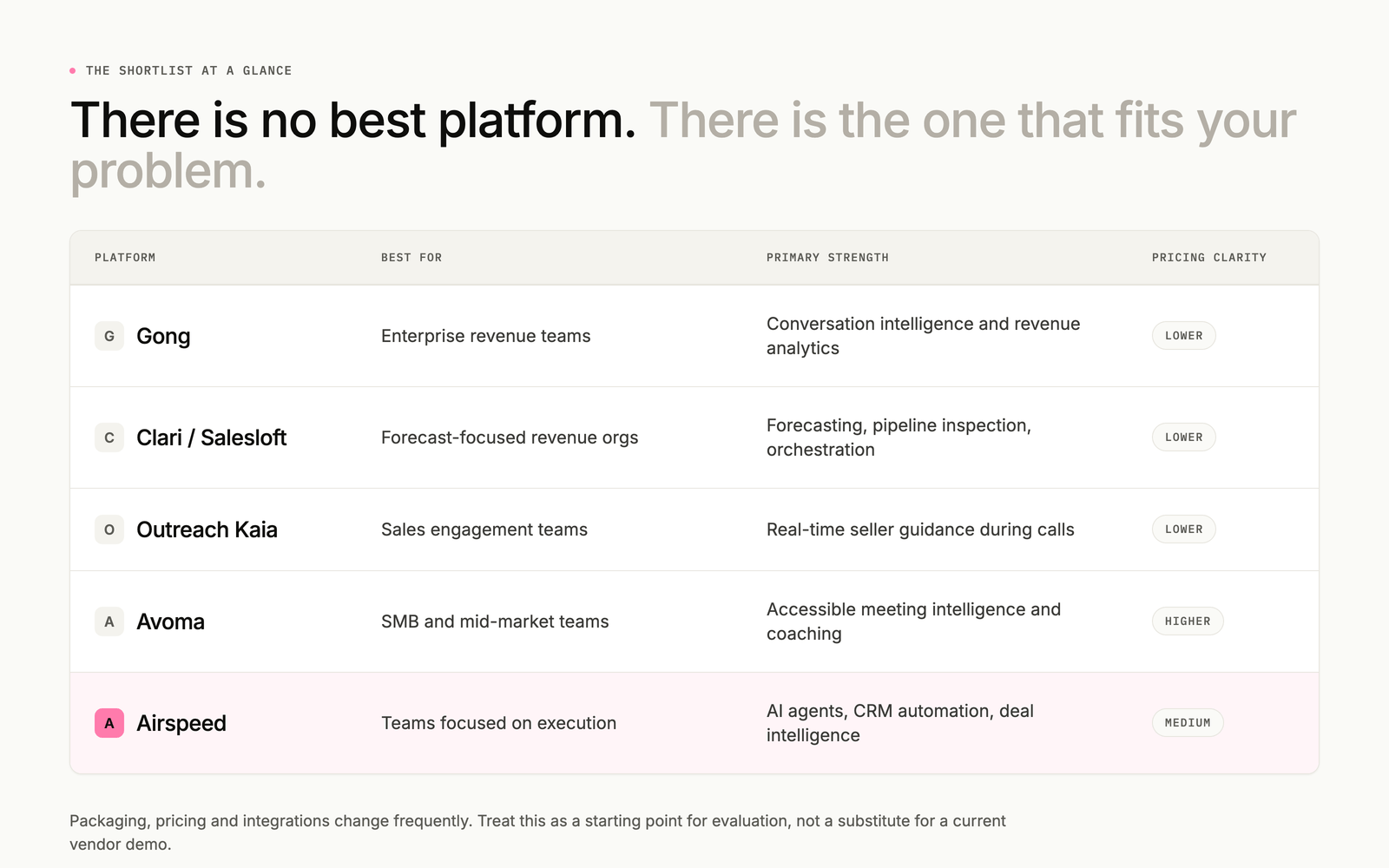
There is no single best platform for every revenue team. The right choice depends on the problem you are trying to solve.
| Platform | Best for | Primary strength |
|---|---|---|
| Gong | Enterprise revenue teams | Conversation intelligence and revenue analytics |
| Clari / Salesloft | Forecast-focused revenue organizations | Forecasting, pipeline inspection, revenue orchestration |
| Outreach Kaia | Sales engagement teams | Real-time seller guidance and conversation intelligence |
| Avoma | SMB and mid-market teams | Accessible meeting intelligence, coaching, revenue intelligence |
| Airspeed | Revenue teams focused on execution | AI agents, CRM automation, deal intelligence, revenue workflows |
The important question is not which tool has the most features. It is which platform turns customer conversations into measurable improvements in how your revenue team operates.
What is conversation intelligence software?
Conversation intelligence software uses AI to record, transcribe, analyze, and extract insights from business conversations. For sales teams that usually means discovery calls, demos, qualification calls, executive meetings, negotiations, renewals, and customer calls across video and phone.
Traditional conversation intelligence starts with transcription and search. More advanced platforms identify topics, objections, buyer signals, competitors, sentiment, next steps, and coaching opportunities. The most useful systems then connect those insights to the rest of the revenue workflow: updating CRM fields, creating follow-up tasks, identifying deal risk, preparing reps for meetings, supporting forecasting, scoring calls, and surfacing recurring objections.
Gong, for example, describes its conversation intelligence workflow as recording and transcribing conversations, analyzing topics and buying signals, surfacing risks and coaching opportunities, and using AI agents to generate summaries, update CRM fields, and suggest follow-ups. For a plain definition of the category, see what conversation intelligence actually is.
Conversation intelligence has three maturity levels
A useful way to evaluate the category is to think about three levels of maturity.
| Level | What the software does | Business value |
|---|---|---|
| 1. Capture | Records, transcribes, summarizes, and stores conversations | Saves note-taking time |
| 2. Analyze | Identifies themes, objections, buyer signals, and coaching opportunities | Improves manager visibility and rep performance |
| 3. Act | Updates CRM, flags risk, supports forecasting, creates tasks, and triggers workflows | Connects conversations to revenue execution |
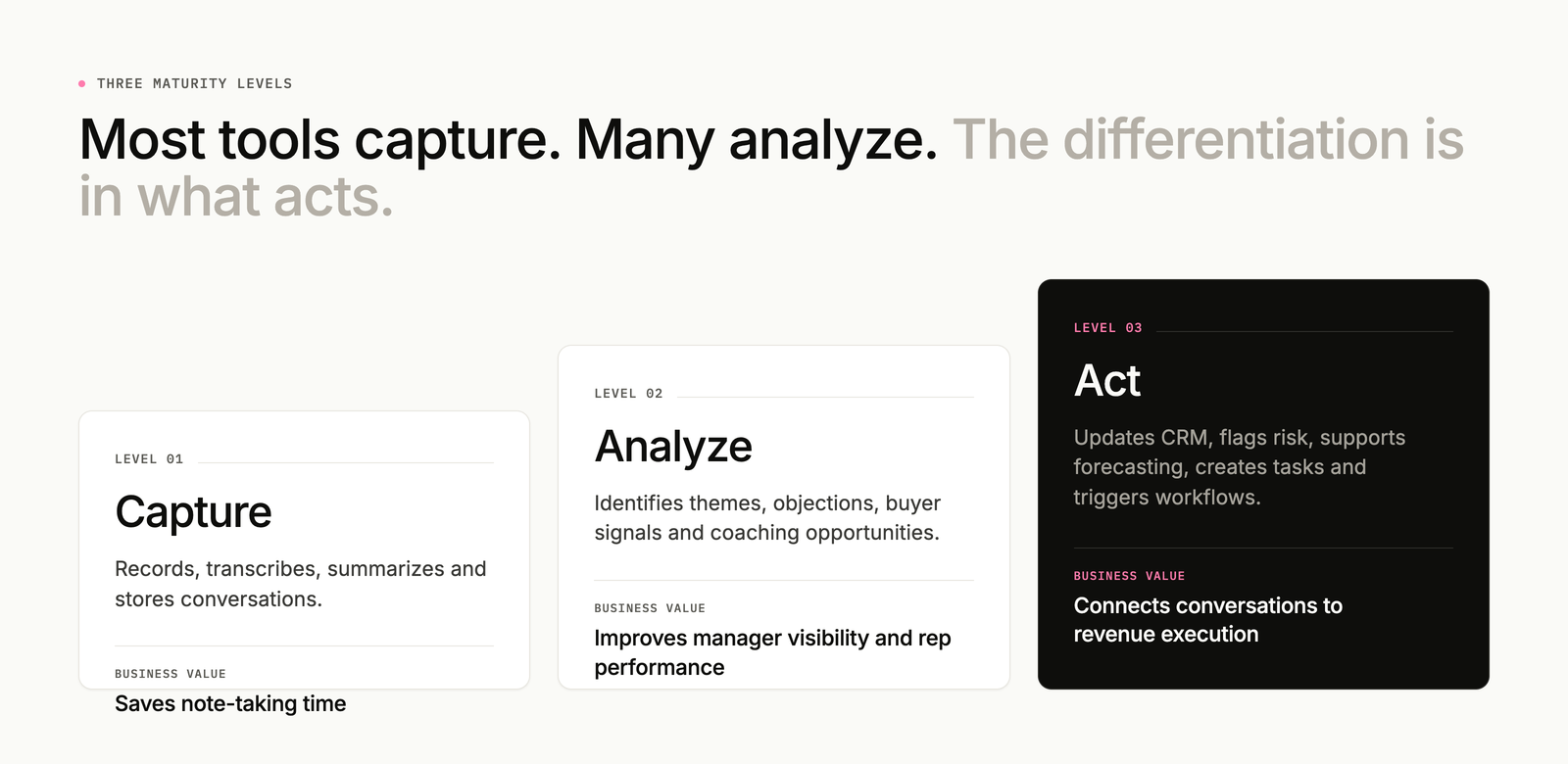
Most conversation intelligence products handle capture. Many handle analysis. The real differentiation increasingly comes from what happens at level three: action.
What should conversation intelligence software do?
The feature checklist has expanded significantly. When you evaluate platforms, look past recording and transcription.
1. Conversation capture and transcription
At minimum, a platform should make it easy to capture and search customer conversations. Evaluate Zoom, Google Meet, and Microsoft Teams support, phone calls, external recordings, automatic recording, transcription accuracy, language coverage, recording consent, and searchability. The goal is not a library of calls. It is a usable data layer built from customer conversations.
2. Conversation analysis
Advanced platforms analyze conversations for signals a manager could never find manually across hundreds of calls: topics, objections, competitor mentions, buying signals, sentiment, questions, next steps, stakeholder involvement, pricing discussions, product requests, and qualification signals. The key question is whether the platform identifies meaning and patterns rather than matching keywords.
3. Sales coaching
Conversation intelligence gives managers a much larger sample of rep behavior to coach against. Look for automated call scoring, custom scorecards, methodology tracking, rep benchmarking, skill-gap identification, coaching recommendations, call playlists, manager comments, coaching assignments, and performance trends. The goal is not more listening. It is spending limited coaching time on the behaviors that matter most.
4. CRM integration
CRM integration is one of the most important criteria for RevOps teams, and it needs more scrutiny than a logo on an integrations page. Ask whether the platform can update custom fields, update contacts and opportunities, create tasks, capture next steps, update qualification fields, let reps approve changes, maintain an audit trail, let RevOps configure the rules, and support two-way sync. A platform that attaches a transcript to a record is very different from one that turns a conversation into structured CRM data.
5. Automated CRM data entry
This distinction is becoming the decisive one. CRM synchronization moves information between systems. Automated CRM data entry interprets a conversation and uses it to populate structured CRM information: business pain, decision criteria, budget, timeline, decision makers, competition, next steps, qualification methodology, and deal risks. That removes a large share of the manual administrative work a rep does after every call.
6. Deal risk visibility
A CRM opportunity may show a deal as Commit. The conversation might tell a different story: the champion has not joined the last three meetings, procurement has not been engaged, the buyer mentioned a competitor, the next meeting has been pushed three times, pricing concerns are unresolved, or a critical stakeholder has gone silent. Good deal risk visibility connects those signals to the opportunity so managers can investigate before the quarter ends.
7. Sales forecasting
Conversation intelligence and sales forecasting are related, but they are not the same thing. A conversation intelligence platform may provide signals that inform a forecast without providing a complete forecasting workflow. Ask whether the platform provides deal risk signals, pipeline inspection, forecast roll-ups, forecast categories, historical accuracy, scenario planning, stakeholder engagement signals, and the evidence behind every recommendation. The more important question: can a sales leader understand why a deal is likely, or unlikely, to close?
8. Revenue team analytics
Conversation data is valuable well outside the sales org. Revenue teams use it to identify recurring objections, competitive mentions, product requests, pricing concerns, customer pain points, win/loss patterns, messaging that resonates, expansion signals, churn signals, and market trends. That makes conversation intelligence a potential source of intelligence for sales, marketing, product, customer success, and RevOps, not only for sales managers.
How we evaluated the best conversation intelligence platforms
Rather than ranking vendors by the number of AI features they advertise, evaluate them across six dimensions.
| Evaluation area | Weight | What to evaluate |
|---|---|---|
| Conversation capture and analysis | 15% | Recording, transcription, search, topics, summaries, buyer signals |
| Sales coaching | 20% | Scorecards, automated scoring, coaching workflows, rep trends |
| CRM automation | 20% | CRM write-back, custom fields, tasks, next steps, governance |
| Forecasting and deal risk | 20% | Risk signals, pipeline inspection, forecasting, evidence |
| Revenue team analytics | 15% | Cross-call trends, objections, stakeholders, competitive insights |
| Implementation and total cost | 10% | Pricing, setup, integrations, administration, adoption |
One rule matters more than the rest: a feature appearing on a vendor’s website does not mean it is included in every plan. Distinguish between native functionality, included functionality, configurable functionality, paid add-ons, separate products, vendor-reported capabilities, and capabilities that need validation in a trial.
Best conversation intelligence software compared
1. Airspeed, best for action-oriented revenue execution
Airspeed takes a different approach to the category. Instead of treating the conversation as the end product, Airspeed treats it as the beginning of a revenue workflow. Its AI agents analyze customer conversations and turn those signals into CRM updates, deal intelligence, forecasting inputs, coaching, and downstream actions.
Best for: B2B revenue teams that want to cut manual revenue operations work and connect customer conversations directly to execution.
Key strengths: automated CRM data entry, deal intelligence, AI-powered coaching, forecasting support, call preparation, AI agents, revenue workflow automation, and CRM-connected execution.
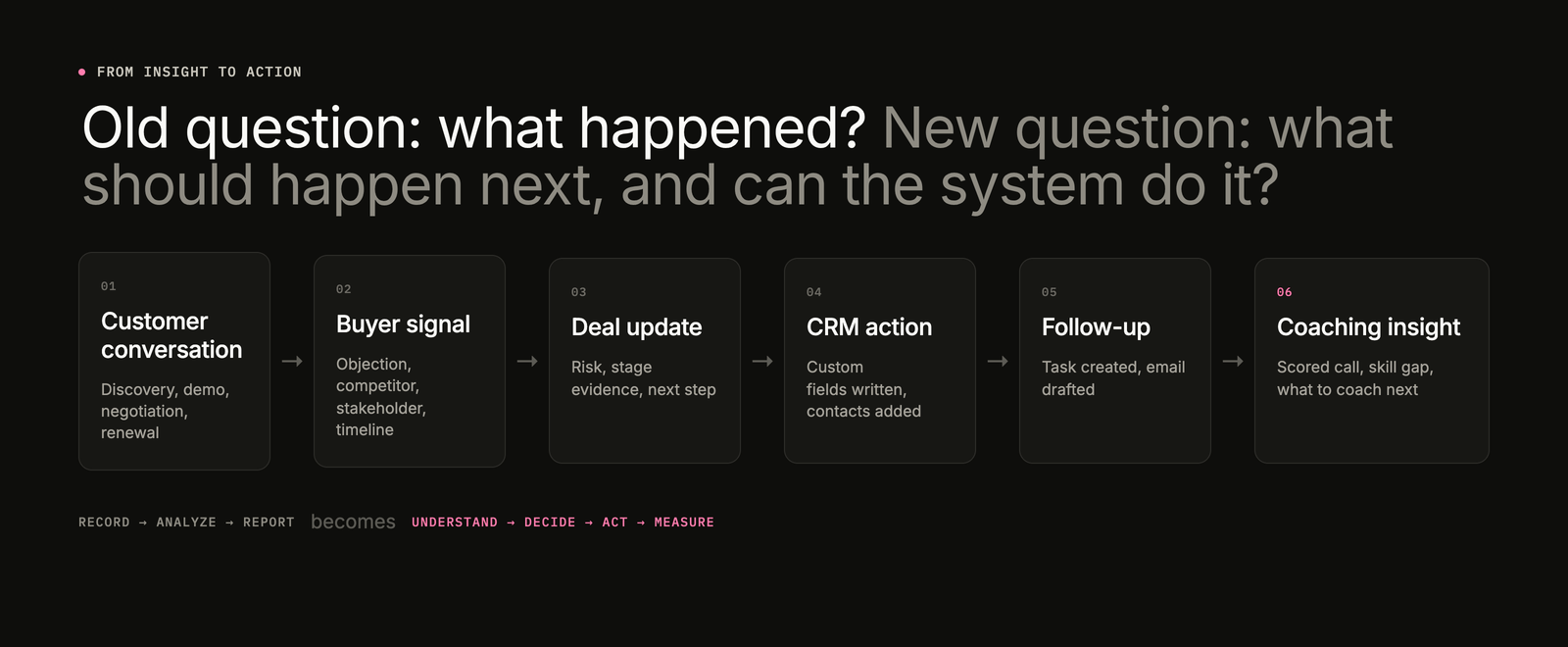
The key difference. Traditional conversation intelligence asks what happened. Airspeed is built to answer the next question: what should happen next, and can the system do it? One conversation becomes a buyer signal, a deal update, a CRM action, a follow-up, and a coaching insight.
Choose Airspeed if your biggest problem is not a lack of recordings. It is the work that happens after the conversation: CRM updates, deal inspection, follow-ups, forecasting prep, coaching, and revenue workflows.
2. Gong, best for enterprise revenue intelligence
Gong is one of the most established names in the category and has expanded well beyond call recording. Its current positioning includes conversation intelligence alongside deal insights, coaching, forecasting, pipeline management, and AI agents.
Best for: enterprise revenue organizations that want deep conversation analytics inside a broad revenue intelligence platform.
Key strengths: conversation analysis, sales coaching, deal intelligence, revenue analytics, forecasting capabilities, CRM integrations, and a large ecosystem.
What to consider. Gong is best evaluated as an enterprise revenue platform rather than a call recording tool. That makes it powerful for large organizations, and it makes total platform cost, required modules, implementation, minimum commitments, included capabilities, and administrative overhead worth pricing carefully. Teams weighing the switch can compare the two directly in our Airspeed vs Gong breakdown.
Choose Gong if your primary goal is deep conversation analysis and revenue intelligence across a large sales organization.
3. Clari / Salesloft, best for forecast-connected revenue orchestration
Clari has historically focused on forecasting, pipeline inspection, and revenue operations, and Clari Copilot brought conversation intelligence into that ecosystem. Salesloft has also built conversation intelligence into its sales engagement platform. The category is consolidating quickly, so verify current product naming, packaging, and ownership when you evaluate either.
Clari Copilot highlights conversation intelligence, buyer signals, coaching, playbooks, and information that can feed pipeline and forecasting workflows.
Best for: revenue organizations where forecasting and pipeline governance are central to the buying decision.
Key strengths: forecasting, pipeline inspection, conversation intelligence, buyer signals, sales engagement, revenue orchestration, and coaching.
What to consider. The question is not whether the platform can analyze conversations. It is how conversation intelligence fits the broader revenue workflow, and which capabilities require separate products or modules.
Choose Clari / Salesloft if forecast accuracy, pipeline governance, and revenue orchestration matter more than conversation intelligence as a standalone system.
4. Outreach Kaia, best for real-time seller guidance
Outreach approaches the category from a sales execution and engagement perspective. Its Kaia product supports conversation recording, transcription, summaries, topics, translations, and coaching workflows, and Outreach documentation describes CRM synchronization and recording-consent configuration. The broader platform connects conversation intelligence to sales engagement, pipeline, deal management, forecasting, and seller workflows.
Best for: teams already invested in Outreach, or teams that want conversation intelligence alongside sales engagement.
Key strengths: real-time seller assistance, battlecards, conversation summaries, transcription, topic tracking, follow-up support, CRM synchronization, and sales engagement.
What to consider. Kaia’s value is usually highest when the organization already runs the broader Outreach platform. Compare the total cost and workflow implications of adopting a sales engagement suite against adding a dedicated conversation intelligence system.
Choose Outreach if you want conversation intelligence tied tightly to sequencing and seller workflows.
5. Avoma, best for accessible and modular meeting intelligence
Avoma combines meeting assistance, conversation intelligence, coaching, and revenue intelligence. Its platform includes AI summaries, call scoring, custom scorecards, topic and objection tracking, coaching, deal signals, CRM updates, and revenue intelligence. Avoma also publishes pricing publicly, which makes initial costs easier to model than with most enterprise platforms.
Best for: SMB and mid-market sales teams that want meeting intelligence and coaching without committing to a large enterprise revenue platform.
Key strengths: meeting intelligence, conversation intelligence, automated call scoring, sales coaching, CRM integrations, deal signals, public pricing, and modular packaging.
What to consider. Model the total cost once conversation intelligence and revenue intelligence are added to the base meeting assistant, since the entry price rarely covers the full evaluation list.
Choose Avoma if you want an accessible, modular platform and value transparent pricing.
Conversation intelligence software comparison
| Platform | Best for | Sales coaching | CRM automation | Forecasting / deal risk | Pricing transparency |
|---|---|---|---|---|---|
| Gong | Enterprise revenue intelligence | Strong | Strong | Strong | Lower |
| Clari / Salesloft | Forecast-connected revenue orchestration | Strong | Strong | Strong | Lower |
| Outreach Kaia | Seller guidance and engagement | Strong | Strong | Strong | Lower |
| Avoma | Accessible meeting and revenue intelligence | Strong | Strong | Strong | Higher |
| Airspeed | Revenue execution and workflow automation | Strong | Strong | Strong | Medium |
Feature availability, packaging, pricing, and integrations change frequently, and this table reflects vendor positioning as of September 2026. Treat it as a starting point for evaluation rather than a substitute for a current demo. For side-by-side ratings and pricing notes, see our conversation intelligence platform ratings.
Best conversation intelligence software by use case
Best for sales coaching: Gong. If your objective is a data-driven coaching culture, prioritize call scoring, methodology tracking, rep benchmarking, and coaching workflows. Gong is a strong option for conversation analytics at enterprise scale.
Best for sales forecasting: Clari / Salesloft. If forecasting and pipeline governance are the primary problems, start with platforms designed around revenue forecasting rather than picking a conversation tool first. The point is connecting conversation signals to the forecast, not running a separate analytics layer.
Best for automated CRM data entry: Airspeed. If your biggest RevOps problem is the manual work of keeping Salesforce or HubSpot current, evaluate how deeply the platform turns conversations into structured CRM updates. Airspeed builds its agents around exactly that.
Best for real-time call guidance: Outreach. For teams that want help while a seller is live on a call, real-time guidance and battlecards belong at the center of the evaluation.
Best for accessible pricing: Avoma. Public pricing makes it easier for smaller teams to model costs, though you should still compare the complete package rather than the entry-level meeting assistant.
Best for deal risk visibility: compare the workflow, not the feature list. Most leading platforms surface some form of deal signal. What matters is what happens afterward. A useful deal risk workflow answers what the risk is, what buyer evidence supports it, how serious it is, who needs to act, what they should do, and whether the action was completed. That last step is where conversation intelligence overlaps with revenue execution.
Conversation intelligence vs. call recording
These terms get used interchangeably, and they are not the same thing.
A call recording platform primarily provides audio and video capture, transcription, search, playback, and summaries.
Conversation intelligence adds topic analysis, buyer signals, objection tracking, coaching, call scoring, deal insights, CRM integration, and revenue analytics.
Revenue execution adds a further layer that connects those insights to action: CRM updates, follow-up tasks, deal risk workflows, forecast inputs, coaching workflows, meeting preparation, and automated processes.
The progression runs record, analyze, automate, act, measure. That framework is far more useful than asking which vendor has the best AI.
How conversation intelligence improves sales coaching
Sales managers do not have time to listen to every call, which creates a coaching problem: most managers coach from a tiny sample of rep behavior.
Conversation intelligence increases that sample dramatically. Instead of reviewing two calls from a rep, a manager can analyze patterns across dozens of conversations. Is the rep asking enough discovery questions? Are they identifying decision makers? Are they handling pricing objections well? Are they setting clear next steps? Are they following the methodology? Are they talking too much? Are they spotting competitive threats?
The most valuable platforms do not stop at identifying the problem. They help a manager decide what to coach next, then show whether the behavior changed on the following call.
How conversation intelligence supports sales forecasting
Forecasting traditionally depends on CRM fields and rep judgment. The most important information about a deal usually lives somewhere else: inside the conversation.
A CRM might say stage Proposal, close date September 30, forecast Commit. The conversation might reveal “we still need to get procurement involved,” or “we are evaluating one other vendor,” or “let’s reconnect next month.” Those statements change how a manager should think about the opportunity.
Conversation intelligence provides another evidence layer for the forecast. The caveat matters: it does not make forecasts accurate on its own. The organization still needs clean CRM data, consistent process, manager adoption, and a shared definition of what counts as risk. Our post on why most sales forecasts are wrong covers where the gaps usually sit.
How conversation intelligence automates CRM data entry
Manual CRM administration is one of the most persistent problems in sales organizations. After a call, a rep writes notes, updates the opportunity, updates qualification fields, adds contacts, records next steps, creates tasks, sends a follow-up, updates the forecast, and alerts their manager. Every extra step is another chance for the record to end up incomplete or stale.
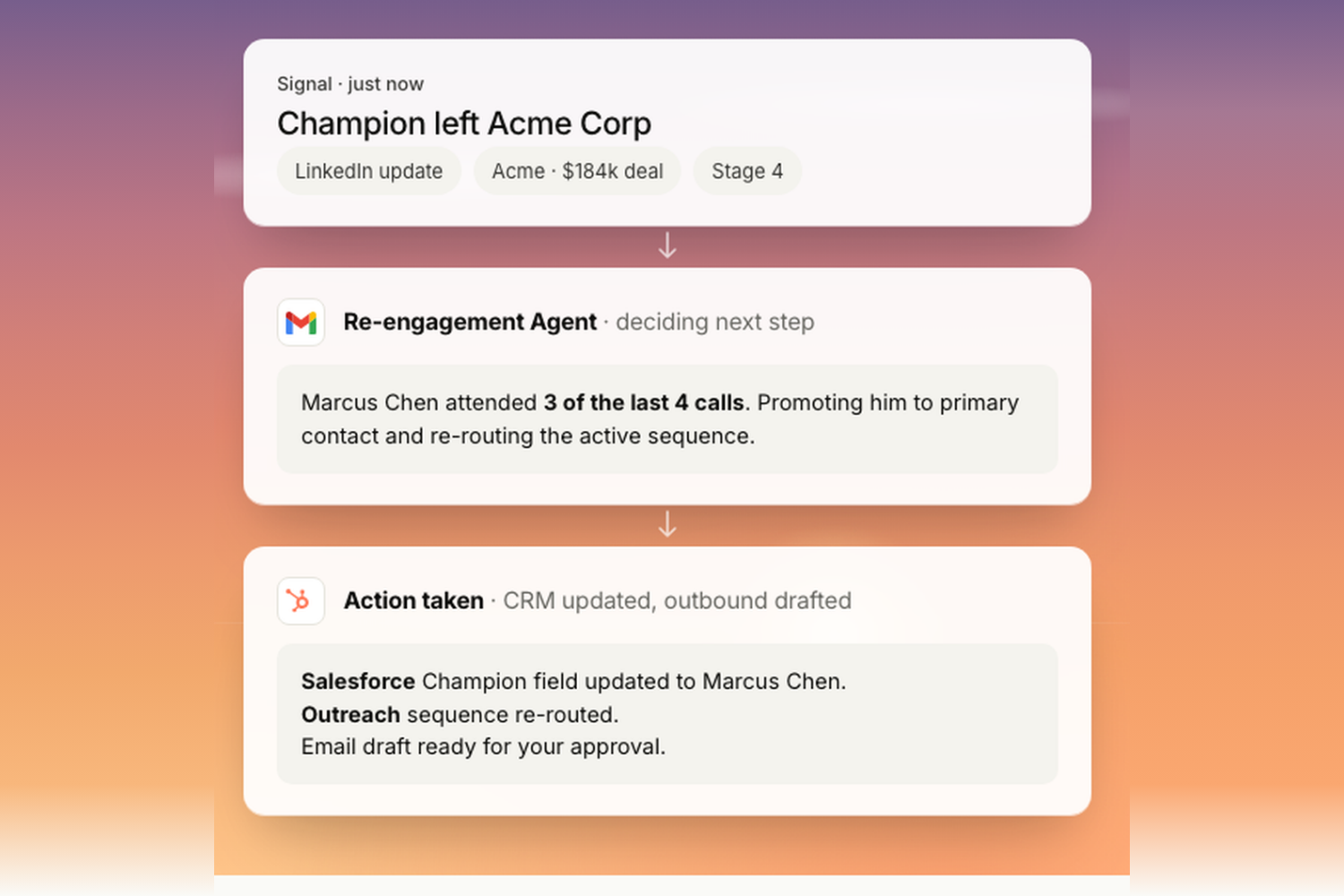
AI-powered CRM automation uses the conversation itself as the source. The conversation identifies budget, identifies the decision maker, detects a competitive mention, extracts the next step, updates the CRM, creates the follow-up, and flags deal risk.
The best systems also give RevOps governance over what gets written, how fields are mapped, and whether human approval is required before anything syncs.
Questions to ask during a conversation intelligence demo
Do not spend the demo asking whether the vendor has transcription. Ask questions that expose how the platform will work inside your revenue organization.
Conversation capture. Which meeting and phone platforms are supported? Can recorded calls be uploaded? How accurate is transcription? How are recording consents handled? Which languages are supported?
AI analysis. Can we create custom topics and trackers? Does the system identify meaning rather than exact keywords? Can it analyze multiple conversations from the same account? Can it identify buyer signals? Can managers search the entire conversation library?
Sales coaching. Can we create custom scorecards? Are calls scored automatically? Can the platform identify skill gaps across reps? Can managers build coaching playlists? Can we measure improvement over time?
CRM integration. Which CRM objects can be updated? Can the system write to custom fields? Can it create tasks and next steps? Can reps approve changes before they sync? Is there an audit trail?
Forecasting and deal risk. What signals determine deal risk? Can managers see the evidence behind a flag? Is forecasting native? Can it compare conversational evidence with the CRM stage? Can it identify stalled or slipping deals?
Business impact. How long does implementation take? What does RevOps need to configure? What share of calls needs to be captured? How do you measure ROI? What happens when the AI gets something wrong?
Common conversation intelligence implementation mistakes
Buying the software is the beginning, not the finish line.
1. Buying a call library instead of solving a business problem. If your problem is forecast accuracy, do not optimize for recording volume. If your problem is CRM data quality, do not optimize for transcript quality. Start with the business outcome.
2. Measuring adoption instead of impact. “80% of reps logged in” is not an ROI metric. Track CRM field completion, admin time saved, forecast accuracy, deal risk detection, coaching frequency, rep ramp time, and pipeline inspection time.
3. Automating bad CRM processes. AI does not fix broken CRM architecture. Before you enable automated updates, define field ownership, data standards, required fields, approval rules, conflict resolution, and audit requirements.
4. Ignoring manager behavior. A platform can identify ten coaching opportunities. If managers act on none of them, the software is not creating value.
5. Treating AI output as automatically correct. AI-generated CRM updates and deal signals need governance, a correction path, and a way to improve the workflow over time.
What metrics should you track after implementation?
The strongest programs measure business outcomes, not software usage.
Adoption: share of eligible calls captured, weekly active users, calls reviewed by managers, scorecard completion, and CRM update acceptance rate.
Sales coaching: coaching sessions per rep, time from call to coaching, score improvement, discovery quality, objection handling, and new-rep ramp time.
CRM and RevOps: field completion, data freshness, opportunities with documented next steps, manual data-entry time, and activity logging coverage.
Pipeline and forecasting: forecast variance, forecast accuracy, slipped-deal rate, stage aging, deal cycle time, win rate, pipeline coverage, and time from risk detection to action.
One caveat worth repeating to your exec team: do not promise that conversation intelligence automatically raises win rates. The software creates a better data and workflow layer. Business impact depends on adoption, configuration, data quality, and whether managers and reps act on what it surfaces.
How much does conversation intelligence software cost?
Pricing varies significantly across the category. Some vendors price per user. Others use platform fees, minimum seat commitments, enterprise contracts, or separate modules for forecasting and revenue intelligence.
When comparing pricing, look past the advertised per-seat number and calculate total cost of ownership: software, implementation, integrations, add-ons, administration, and training.
Also ask whether you are paying separately for recording, conversation intelligence, coaching, forecasting, revenue analytics, CRM automation, AI agents, API access, and professional services. A cheaper license becomes expensive quickly if your team needs several additional products or significant manual administration to run it.
The future of conversation intelligence: from insight to action
The category is changing. The early value proposition was “we record and analyze every sales call.” Then it became “we help managers understand what is happening across the pipeline.” The next step is “we turn what happens in customer conversations into action.”
That means connecting conversation data to revenue intelligence, the CRM, the workflow, the action, and the outcome. This is where AI agents get interesting. Instead of giving a rep another dashboard to check, an agent can take the next step: update the CRM, draft the follow-up, flag the opportunity, prepare the rep, create a task, surface the risk, update forecast inputs, or route information to another team.
Airspeed is built around this model, running revenue-focused AI agents that work from customer conversations and turn them into pipeline, forecasts, coaching, and CRM updates. The broader category is heading the same way: conversation data is becoming an input to revenue workflows rather than an output stored in a call library.
How to choose the right conversation intelligence software
Start with the problem, not the vendor.
- Managers do not have enough time to coach. Prioritize automated scoring, scorecards, coaching workflows, and rep analytics.
- Forecasts are unreliable. Prioritize deal inspection, buyer signals, pipeline analytics, and forecasting.
- CRM data is stale. Prioritize automated CRM data entry, custom field mapping, governance, and write-back.
- Reps need help during calls. Prioritize real-time guidance and battlecards.
- Customer insights are trapped in calls. Prioritize cross-call analytics, topic tracking, and revenue team analytics.
- Reps spend too much time on post-call admin. Prioritize AI agents and workflow automation.
- You want all of the above. Decide whether you need a standalone conversation intelligence tool or a broader revenue execution platform.
If your evaluation keeps running into insights that never reach the deal, the six gaps where conversation intelligence loses information are worth reading before you shortlist.
Final verdict
The best conversation intelligence software is not the platform with the most recordings, the longest feature list, or the most AI-generated summaries. It is the platform that helps your revenue team make better decisions and take better action.
For enterprise organizations focused on deep conversation analytics, Gong remains an important platform to evaluate. For teams centered on forecasting and pipeline governance, Clari/Salesloft belongs on the shortlist. For sales organizations already invested in sales engagement, Outreach’s conversation intelligence is compelling. For teams that want accessible meeting and conversation intelligence, Avoma is worth considering. And for revenue teams whose biggest problem is what happens after the call, Airspeed takes a different approach: AI agents that turn conversations directly into revenue execution.
The category is moving from record, analyze, report toward understand, decide, act, measure. That is the shift to evaluate when you choose conversation intelligence software in 2026.
The right platform is not the one that tells you what happened. It is the one that helps your team do something about it. To see what that looks like on your own pipeline, book a demo.
Frequently asked questions
Which conversation intelligence software is best in 2026?
There is no single best platform. Gong suits enterprise revenue teams that want deep conversation analytics. Clari and Salesloft suit organizations where forecasting and pipeline governance drive the decision. Outreach Kaia suits teams that want real-time seller guidance inside a sales engagement platform. Avoma suits SMB and mid-market teams that value accessible, publicly listed pricing. Airspeed suits revenue teams whose real problem is the work that happens after the call: CRM updates, deal inspection, follow-up, and coaching prep.
Our managers do not have time to coach. What should we prioritize?
Prioritize automated call scoring, custom scorecards, methodology tracking, rep benchmarking, and coaching workflows that assign and measure a specific behavior. The point is not to help managers listen to more calls. It is to spend their limited coaching time on the calls and behaviors that actually move win rates, and to show whether the behavior changed on the next call.
Our forecast is unreliable. What should we prioritize?
Prioritize deal inspection, buyer signals, pipeline analytics, and evidence behind every risk flag. A conversation intelligence platform may provide signals that inform a forecast without providing a complete forecasting workflow, so confirm which you are buying. The question a sales leader needs answered is why a deal is likely or unlikely to close, with the conversation evidence attached.
Our CRM data is stale. What should we prioritize?
Prioritize automated CRM data entry rather than CRM synchronization. Synchronization moves a transcript or summary into Salesforce or HubSpot. Automated data entry interprets the conversation and populates structured fields: pain, decision criteria, budget, timeline, decision makers, competition, next steps, and deal risks. Ask about custom field mapping, rep approval, audit trails, and what happens when the conversation conflicts with what the CRM already says.
What is the difference between conversation intelligence and call recording?
Call recording captures audio or video, transcribes it, and makes it searchable. Conversation intelligence adds topic analysis, buyer signals, objection tracking, call scoring, coaching, deal insights, and CRM integration on top. A newer layer, revenue execution, connects those insights to action: CRM updates, follow-up tasks, deal risk workflows, and forecast inputs. The progression runs record, analyze, automate, act, measure.
How much does conversation intelligence software cost?
Pricing varies widely across the category. Some vendors price per user, others use platform fees, seat minimums, enterprise contracts, or separate modules for forecasting and revenue intelligence. Compare total cost of ownership rather than the advertised per-seat price: software, implementation, integrations, add-ons, administration, and training. Ask specifically whether recording, coaching, forecasting, revenue analytics, CRM automation, AI agents, and API access are billed separately.