


Front-load the skills that respond to coaching and defer the ones that only respond to volume. Qualification and securing next steps improve within two weeks of drilling and cause the most preventable losses when they’re missing. Comparative product knowledge is the slowest skill to build and the one most programs teach first. Drill the fast skills against recordings of your own reps before the new hire touches live pipeline, score every call from day one, and judge readiness on the gap between a rep’s best and worst call rather than their average.
Ramp time gets treated as a scheduling problem. It’s a sequencing problem.
Some sales skills close in two weeks with a handful of call clips and a drill. Others only close with a few hundred calls in the seat, and no amount of training accelerates them. Most onboarding programs spend their most controlled week on the second kind.
We scored every call across our team, tenured and new, to work out which was which. The split was sharper than expected, and it produced a sequence you can copy. Here’s the program, the drills, and the gates.
Step 1: Sort your skills before you build the schedule
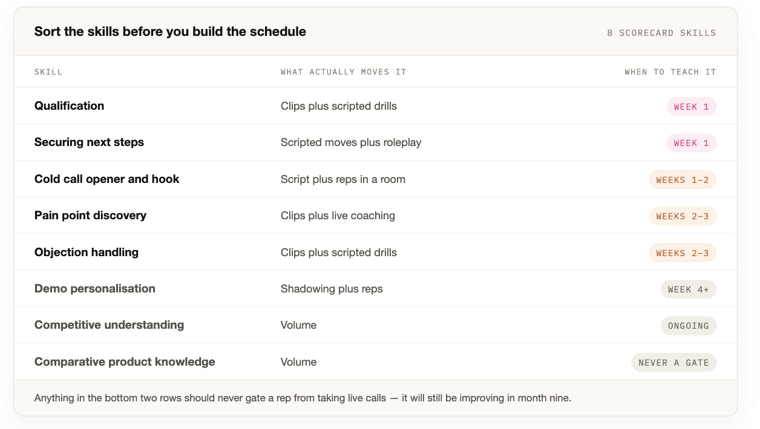
Two questions per skill on your scorecard. Does it improve when a rep watches someone good do it? Or does it only improve with volume?
| Skill | What actually moves it | When to teach it |
|---|---|---|
| Qualification | Clips plus scripted drills | Week 1 |
| Securing next steps | Scripted moves plus roleplay | Week 1 |
| Cold call opener and hook | Script plus reps in a room | Weeks 1 to 2 |
| Pain point discovery | Clips plus live coaching | Weeks 2 to 3 |
| Objection handling | Clips plus scripted drills | Weeks 2 to 3 |
| Demo personalization | Shadowing plus reps | Week 4+ |
| Competitive understanding | Volume | Ongoing |
| Comparative product knowledge | Volume | Ongoing, never a gate |
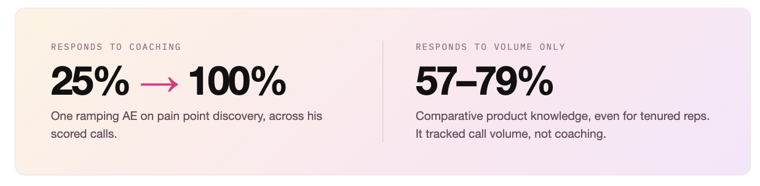
Two findings from our own scoring, to show why the split falls where it does. One ramping AE moved from 25% to 100% on pain point discovery across his scored calls, which is a skill responding to coaching almost immediately. Comparative product knowledge, by contrast, sat between 57% and 79% even for tenured reps and tracked call volume far more closely than it tracked any coaching we did.
The practical version: anything in the bottom two rows should never gate a rep from taking live calls, because it will still be improving in month nine.
Step 2: Week one, drill qualification to a written standard
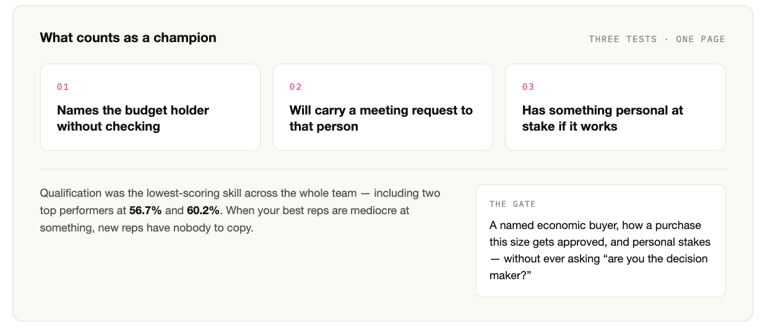
Qualification is worth teaching first because it’s simultaneously the weakest skill in most orgs and the cheapest to fix. In our scoring it was the lowest-scoring skill across the entire team, including two top performers sitting at 56.7% and 60.2%. When your best reps are mediocre at something, new reps have nobody to copy, and it stays broken indefinitely.
It’s also where the preventable losses come from. Reviewing our closed-lost record, four deals died when a single point of contact left the business with no backup relationship developed. One never reached the economic buyer at all. One leaned on a contact who was enthusiastic but had no internal weight. That is the failure mode behind a champion who cannot sell your deal without you in the room.
The drill:
Write the standard down first. One page defining what counts as a champion at your company. Ours has three tests: they can name the budget holder without checking, they will carry a meeting request to that person, and they have something personal at stake if the project works.
Review three clips. One call where a rep qualified properly, one where a rep accepted a vague answer, one closed-lost call where the contact was never a real champion. Ten minutes each.
Teach four specific questions the rep memorizes, rather than a framework.
Who else would need to be comfortable with this before it goes ahead?
Walk me through how something this size got approved the last time you bought a tool.
If this works the way we’ve described, what changes for you personally?
Who’d be annoyed if this project happened?
Roleplay against the hard case. The manager plays an enthusiastic contact with no authority, which is the failure mode that actually loses deals. Not a hostile buyer.
The gate: in a ten-minute mock discovery, the rep gets to a named economic buyer, an explanation of how a purchase this size gets approved, and something the contact personally has at stake. Without ever asking “are you the decision maker?”
Step 3: Week one, second half, ban the soft close
Securing a next step is the widest skill gap we found between new and tenured reps. Several SDRs scored between 28% and 47% on it. Two tenured reps scored 77.8% and 83.3%. That is a gap you close with scripts, not with time.
The underlying move is simple: never accept a timing objection as an ending. Convert it into a calendar hold on the call. Here’s a line from one of our own cold calls that scored 100%:
When, maybe if I penciled in a placeholder for the back end of September, would that be okay?
The prospect said yes. The follow-up went out the same afternoon for 2:30.
The drill:
Start with a banned phrases list on the wall. “I’ll follow up by email.” “Let me know what works.” “I’ll ping you next week.” Then give the rep three approved patterns to replace them with:
The placeholder. Book a provisional slot on the call, on the explicit understanding it can move. Removes the commitment objection while keeping the date.
The named prerequisite. “Shall we pencil the 12th, on the basis that your review lands the week before? If it slips, we move it.” Ties the meeting to their event, not your pipeline.
The trade. “I’ll send the integration detail by Thursday. Can we get twenty minutes Friday to go through it?” Gives them a reason the meeting exists.
The gate: ten consecutive roleplay calls, every one ending with a specific date and time in the calendar. Not nine.
Step 4: Week two, run drills against your own recordings
Generic sales training content fails for a boring reason: the objections don’t match. Your reps will hear your objections, about your integrations, against your incumbents. So build a clip library from your own calls.
Sort your scored calls by skill, take the top three for each, and cut them to roughly 90 seconds. Five clip types cover most of what a new rep needs:
The recap. A rep playing the problem back before showing anything. From a demo that scored 100%: “If I just quickly recap my understanding… reps losing a few hours a week just wrestling data into [the CRM]… is that a fair sort of summary game plan?”
The falsifiable pain question. A question the buyer has to confirm or correct, rather than one they can shrug at.
The refusal to demo early. A rep declining to show screens because the problem isn’t clear yet.
The objection reframe. Ours includes a one-line migration answer: “No, good news, we can backfill your calls with [your existing tool].”
The next step. The placeholder move above.
Run each one the same way. Watch the clip, name the move, then the rep performs the same move in a roleplay and gets scored against the same rubric a real call would be scored against. The scoring is the part people skip, and it’s the part that makes the drill stick. The same clip library is what a talk track built from your top performers is made of, so build one and use it twice.
Step 5: Weeks three to six, live calls scored from the first one
Put the rep on live calls once they’ve passed the two gates, not once they’ve finished product training.
Score every call from the first one, including internal roleplays. If you start scoring at month three, you have no baseline and no way to see improvement.
Run 1:1s off the scorecard rather than off the deal list. “You scored 3 on pain discovery” is useless on its own, so pair it with the moment in the transcript and a clip of someone doing it well.
Coach one skill per week. Reps who get five pieces of feedback change nothing.
Move product certification here, in week three or four, where it belongs.
Step 6: Measure the spread, not the average
This is the change that costs nothing and tells you the most.
One of our ramping AEs sat 1.5 points off the org average, which on a dashboard reads as someone who has arrived. She was swinging between 21% and 96% depending on the call. The average was hiding a rep who was excellent a third of the time.
What actually improves during ramp isn’t the average. It’s the variance. A ramped rep is one whose bad calls stop being that bad.
What to put in your dashboard instead:
The gap between the rep’s best and worst call over their last five calls.
Their floor, meaning the worst score in that window, tracked against your org average.
Total scored calls, because the milestone below is a volume number rather than a date.
When to start trusting the numbers: somewhere around 15 to 20 scored calls, in our data, is where the swings start to converge. Before that you’re reading noise. One of our reps opened with a 96%, dropped to 21%, and only settled into a steady 68 to 82% range over her final eight calls.
That’s also a much more honest thing to tell a new hire than “you’ll be at quota in month four.” If you need to put a cost on the weeks you save, run the numbers through the rep ramp calculator.
Five things that add weeks to ramp
Product certification in week one. The least coachable skill, taught in your most controlled week.
Generic training content. The objections don’t match, so the rep has to translate everything.
Waiting until month three to start scoring. No baseline, no visible progress, no early correction.
Reporting averages. Hides exactly the volatility that costs deals.
Judging a rep off one great call. The 96% means nothing. Convergence is the signal.
Where the calls come in
Onboarding gets faster when you stop guessing which skills are missing.
Airspeed scores every call against your scorecards from a rep’s first week, shows you where the variance is, and surfaces the exemplar moments from your own team to drill against. AI roleplay gives the rep somewhere to practice the drills before they touch live pipeline, and coaching puts the feedback in front of them while the call is still fresh. For revenue enablement teams, that is the difference between a ramp plan on a calendar and a ramp plan you can see.
Book a demo to see how Airspeed scores every call from a new rep’s first week.
Frequently asked questions
How long does it take to onboard a new sales rep?
Track scored calls rather than weeks. Scores stop swinging wildly at around 15 to 20 scored calls, which is typically six to ten weeks depending on how much call volume the rep is getting. A rep doing eight calls a week ramps faster than one doing two, and a calendar-based plan cannot see that.
What should sales onboarding cover in week one?
Qualification and securing next steps, drilled against recordings of your own reps, with a written pass standard for each. Both improve quickly with coaching and both show up repeatedly in lost-deal reasons.
Should product training come first in sales onboarding?
No. Comparative product knowledge is the slowest skill to build and correlates with call volume more than with any training. Teach it in week three or four and expect it to keep improving for months.
How do you measure sales onboarding progress?
Score every call against the same scorecard you use for tenured reps, then track the range between the rep's best and worst call over their last five, plus their floor. Averages hide volatility, and volatility is what costs deals.
Why do new reps' scores go down before they go up?
Early calls are unrepresentative. A rep can open with a near-perfect score and drop forty points on their next call. Nothing is wrong. Wait for convergence before you read anything into the numbers.
What should be in a sales onboarding checklist?
Two written pass standards (qualification and next steps), a clip library of your own top-scoring calls organized by skill, a scoring rubric applied from day one, product certification scheduled for week three or later, and a variance-based readiness metric rather than a calendar date.
Can AI shorten sales onboarding?
It removes the bottleneck, which is scoring. Nobody has time to score every call from every rep by hand, so gaps stay invisible and clips stay unfindable. Deciding what to drill and where the pass standard sits is still a human job.


