


Most talk tracks are fiction.
Someone writes one in a Google Doc. Usually someone who has not carried a bag in three years, working from what a top rep said they do when you asked them about it in a QBR. It gets posted in the enablement channel, read once, and quietly dropped from the next refresh.
The writing isn’t the problem. The source is. Reps are unreliable witnesses to their own performance, and not because they’re lying to you. The moves that actually win deals have gone automatic by the time someone is good enough to be worth copying. Ask your best AE why she wins and she’ll tell you she builds trust early. Great. Now put that in a playbook.
You already own better material than anything she’ll give you in a QBR. It’s sitting in your call recordings, untranscribed and unscored, and it is the only honest record of what your top performers actually do on a live call.
We did this on our own calls at Airspeed: 7 scorecards, dozens of scored calls, 186 closed-lost deals. Below is the method, and what we found, including one result that made us stop quoting a coaching metric we’d been repeating for about a year.
What is a sales talk track?
A talk track is a sequence of moves a rep makes at a specific point in a specific call type, in language that has already worked on a real buyer.
It isn’t a script, and it isn’t a battlecard.
That distinction changes what you go hunting for. You’re not collecting sentences for reps to recite. You’re after the structure underneath the sentences: the order of the moves, what has to be true before a rep advances, and a couple of lines that make each move land.
Step 1: Decide what “top performer” means, numerically
Everyone knows who the top reps are. Very few teams can tell you by how much, or at what.
Pick one scorecard per call type and score enough calls that you’re looking at a pattern rather than a highlight reel. Our AE discovery scorecard runs eight skills: pain point discovery, value prop alignment, qualification, rapport, objection handling, active listening, next steps, competitive understanding. If you do not have one yet, start from a sales call scorecard template and cut it down to the skills you will actually coach.
Ours came out like this:
| Rep | Discovery score | Gap vs. org average (70.9%) | Calls scored |
|---|---|---|---|
| Rep A | 79.5% | +8.5pp | 15 |
| Rep B | 79.2% | +8.3pp | 30 |
| Rep C | 77.5% | +6.6pp | 23 |
| Rep D | 77.4% | +6.5pp | 15 |
Demos told a similar story. Against an org average of 81.3%, Rep B scored 89.9% and Rep A 88.1%.
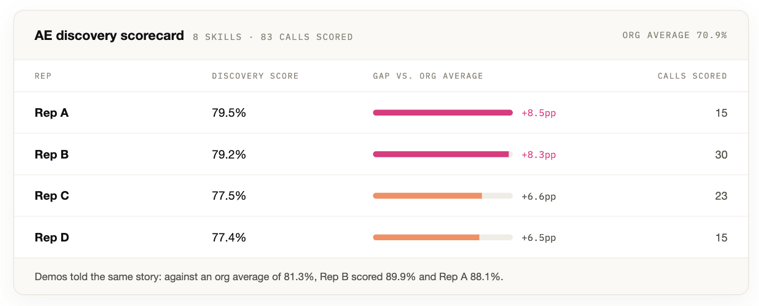
The same two reps sit at the top of both lists. Those are your source calls. Fifteen calls from two reps will teach you more than two hundred from twenty.
Step 2: Find the skill that’s carrying the gap
Here’s where this usually falls apart. You look at your top performers, notice they’re better at more or less everything, and conclude that the answer is for everyone else to be better.
Score at the skill level and the gap almost always collapses onto one or two things.
Ours was pain point discovery. Top reps averaged 4.0 out of 5 on it. The weakest reps in the org averaged 2.8, a 24-point normalized gap and comfortably the widest of the eight skills we measure. Rapport wasn’t it. Product knowledge wasn’t it either, which surprised a few people internally. Our best reps were simply better at getting a buyer to name a problem and then put a number on it.
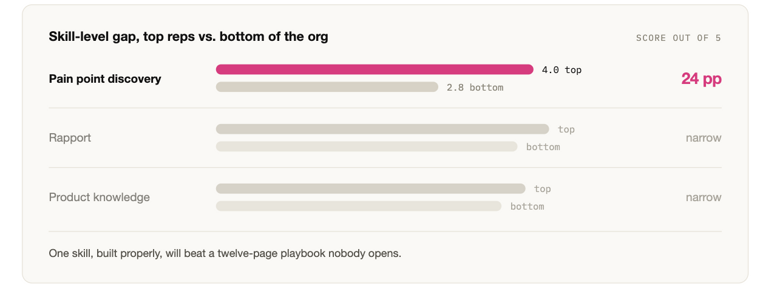
One skill, built properly, will beat a twelve-page playbook nobody opens.
Step 3: Be willing to bin a metric
We’d been repeating the standard conversation intelligence line on talk ratio for a while. Our own data didn’t support it.
Top discovery and demo performers here sit between 50% and 62% talk time. Not 30%. The highest scorers aren’t quiet; they’re active, and they’re steering. They also speak at a fairly measured 173 to 209 words per minute. The fastest talkers in the business, at 238 wpm, are in cold-calling roles, nowhere near the top of the discovery table.
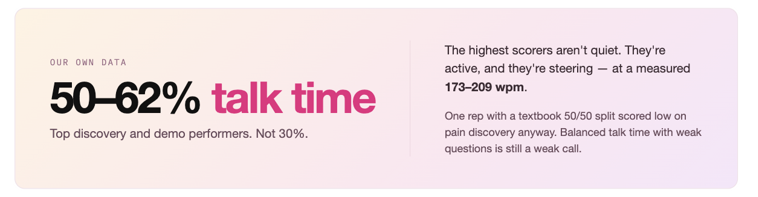
The result that actually changed our minds was smaller than that. One rep with a textbook 50/50 split scored low on pain discovery anyway.
Balanced talk time with weak questions is still a weak call. If your coaching dashboard leads with talk to listen ratio, you’re coaching a proxy for the thing you care about, and your reps will optimize for the proxy.
Step 4: Take the words, not the summary
An AI summary of a great call is useless for this. “Rep established pain and aligned value” gives a struggling rep nothing they can use on Tuesday morning.
Open the transcript, find the moment, take the words as they were said. Six of ours, with the move each one is making.
Hand over the agenda before pitching anything.
I’m keen to get an understanding, lay of the land from you… what’s going on in your world, what your strategic priorities are, the challenges crucially, of course, getting in the way of those.
Turn vague pain into something the buyer has to confirm or correct.
If I was to look at a random deal in your pipeline in Salesforce at the moment, there’s a chance that it wouldn’t accurately reflect reality today?
The buyer can only agree or push back, and either answer moves the deal forward. Compare it to “so what are your challenges around pipeline hygiene?”, which invites a shrug. More of these live in our discovery question bank.
Refuse to demo until the problem is clear. This was twenty minutes into a call where the buyer was actively asking for screens.
I don’t want to jump into a demo yet… I still feel like I’m not super clear on exactly what you’re optimizing for here.
Reframe the incumbent rather than attacking it. The buyer had just renewed with a competitor.
Maybe we’re not competing for their call recorder budget, maybe instead we’re competing for this internal-build budget.
Validate a build-it-ourselves objection before reframing it.
It’s a breath of fresh air to hear you say that… you have a whole business centered around this thing. I’m not going to be able to go and replicate that overnight.
Pin the next step live, instead of waiting on a prerequisite that never arrives.
I wouldn’t suggest waiting until we think Salesforce is up to standard… what I would recommend is we pencil something in for start of September.
None of these are clever. That’s rather the point. They’re plain, specific, and a new rep can use them in week four.
Step 5: Write down the structure
The same six moves showed up, in roughly the same order, in every top-scoring call we looked at.
- Open by handing over the agenda. Don’t pitch first.
- Refuse to pitch until pain is quantified, even when the buyer tries to skip ahead.
- Turn vague pain into a falsifiable statement the buyer has to confirm or correct.
- Ask a provocative competitive question rather than trashing the incumbent.
- Validate the objection before you reframe it.
- Pin a specific next step on the call. Never “I’ll follow up by email.”
Six lines. Everything after that is examples.
Step 6: Put a number on what the gap costs
A talk track lands very differently when it arrives with a price tag attached. So we ran the analysis backwards, across 186 closed-lost deals.
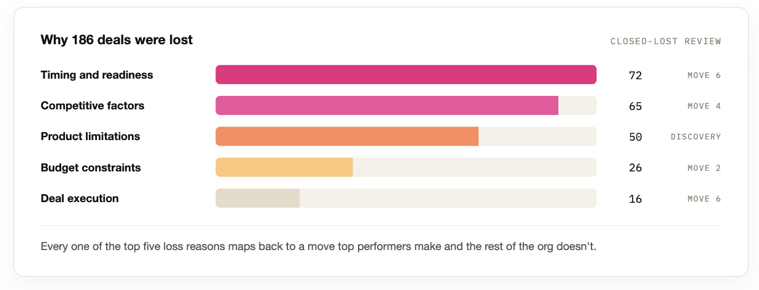
Timing and readiness, 72 deals. No urgency, no pinned next step. The exact inverse of move six.
Competitive factors, 65 deals. Mostly incumbent lock-in that never got reframed. Move four.
Product limitations, 50 deals. Integration gaps that surfaced too late to do anything about. That’s a discovery failure, not a product failure.
Budget constraints, 26 deals. Price objections nobody had pre-empted with quantified pain. Move two.
Deal execution, 16 deals, which includes “failed to secure concrete next steps” as its own named subcategory.
Every one of the top five loss reasons maps back to a move our top performers make and the rest of the org doesn’t. It is the same pattern behind the deals that stall quietly. Open the enablement session with that slide, not with the talk track.
Step 7: Get it into the workflow
A talk track that lives in a document dies in a document. There are three places it has to show up instead.
In the scorecard, so the skill you built the track around is the one being measured on every call.
In pre-call prep, surfaced against the specific account and stage the rep is walking into.
In post-call coaching, as a comparison between what the rep said and what the exemplar said at the same moment.
The third one is the whole job, honestly. “You scored 3 on pain discovery” changes nothing. “Here’s the moment you accepted a vague answer, and here’s how your top scorer handled the same objection last week” changes the next call. That is the loop behind coaching sales reps from call recordings, and it is the part that does not scale on manager time alone.
Step 8: Re-score after 30 days
You built the thing from a number, so go back and check the number.
Re-score the same skill, same reps, thirty days after rollout. If the org average on pain discovery hasn’t moved, either the track is wrong or the coaching loop isn’t closing. Both are fixable. Neither one shows up if you don’t measure it.
The same discipline is what makes a talk track useful to a brand new hire. Once you know which moves carry the gap, you know which ones to drill first when you onboard a new rep.
Where the calls come in
Your top performers already wrote your talk track. They did it live, on calls you recorded, and nobody transcribed the good bits.
Airspeed scores every call against your scorecards, surfaces the exemplar moments, and puts the coaching in front of the rep before the next call rather than in a document they’ll never open. For sales leaders, that turns one rep’s instinct into a team standard you can measure.
Book a demo to see how Airspeed builds talk tracks from your own call record.
Frequently asked questions
How many calls do I need to build a talk track?
Fewer than you would think, provided they are the right calls. Fifteen to thirty scored calls from your two or three highest-scoring reps on a single call type is enough to see the structure. Volume without scoring just gives you a bigger pile.
What is the difference between a talk track and a script?
A script tells a rep what to say. A talk track tells them what to accomplish, in what order, with example language for each move. Scripts break the moment a buyer goes off-piste. Talk tracks do not, because the rep understands the objective behind each move.
Should reps aim for a specific talk ratio?
No. In our data, top discovery and demo performers ran 50 to 62% talk time, and a rep with a perfect 50/50 split still scored poorly on pain discovery. Coach question quality instead.
Which sales skill should I build a talk track around first?
Score your calls by skill and find the widest gap between your best and worst reps. For us that was pain point discovery, by a distance. Yours may well be something else, but it is rarely the skill everyone assumes.
Can AI build talk tracks from call recordings automatically?
It can do the parts humans are bad at: scoring every call to the same standard, finding the skill gap, and pulling the verbatim moments back out. Someone still has to decide which moves are worth institutionalizing. That editorial call is the job.


