

IN THIS EDITION
The forecast is lying to you. Here's why, plus expansion signals, Santorini, and drinks in NYC.
Issue 08 is all signal, no noise: a deep dive on why sales forecasting keeps failing, a live webinar with Thang and Doug May from Harness, a walkthrough on surfacing upsell opportunities before your customers ask, and a few things worth celebrating.
01 · DEEP DIVE
Why your sales forecast keeps lying to you, and what to do about it.
Most forecast misses aren't a people problem. They're a signal problem.
The average B2B forecast is built on what someone remembered to log in the CRM: stage, amount, close date. But only around 35% of sales professionals actually trust their organisation's CRM data. So you're running a complex model on a shaky foundation, then wondering why the number keeps coming in wrong.
Here's what's actually going wrong, and where to fix it.
Start with the data. Seriously.
"Clean data" gets thrown around like it's obvious. It isn't. In practice, clean forecast data means four things:
COMPLETE: Every deal has a close date, an amount, a stage, and a named next step. If any of those are missing, the deal shouldn't be in your forecast.
CURRENT: If a field hasn't been updated in 14 days, it's stale. Set that as your threshold and flag anything that crosses it in your pipeline reviews.
CONSISTENT: Your stages need to mean the same thing across every rep. "Verbal yes" in one rep's pipeline and "contract sent" in another's can both sit at 80%; that's not a pipeline, that's a feeling.
CAPTURED AUTOMATICALLY: Manual CRM entry is where data quality goes to die. Every call, email, and meeting that gets logged automatically is one less field a rep has to remember to update. If you're not pulling activity data in automatically, you're relying on memory, and memory is not a forecasting methodology.
Audit your current pipeline against those four criteria before your next forecast cycle. You'll find the holes fast.
Your funnel is probably one size when it should be three.
B2B buyers in 2026 don't follow a single path. They split across in-person, remote, and digital self-serve, and each moves at a completely different pace. Relationship buyers might run a 90-180 day cycle. Digital self-serve buyers close in 15-45 days. If you're blending those into a single conversion rate, you're systematically underestimating variance, and your forecast will keep missing in ways that are hard to explain.
The fix is to model each segment separately (its own conversion rate, its own lag time) then weight by revenue contribution when you aggregate. More work upfront, but you'll stop being surprised by the same miss every quarter. See the full breakdown with worked examples →
But here's the harder problem: most conversion rates are fiction.
The formula only works if your conversion rates are real. Most aren't. They're a number someone set two years ago, or an average that smooths over the difference between your best and worst reps, or a gut feel that got formalised into a spreadsheet.
The more reliable approach is to go back to the source: your calls. Run your closed-won transcripts through conversational intelligence and let the raw data tell you what actually moved deals forward. Not what reps reported, not what got logged: what was said, when, and by whom. Do that across enough calls and patterns emerge: which objections preceded a close, which stakeholder questions signalled genuine intent, which moments of silence were actually disqualification in disguise.
Those patterns become your real conversion signals, segmented by buyer type, grounded in evidence. It's a higher bar than a spreadsheet. But it's also the difference between a forecast that Finance trusts and one that gets explained away every quarter.
You're forecasting backwards when you should be looking forwards.
Traditional forecasting asks: what closed last quarter? The better question is: what signals predict what closes next? When you factor in call sentiment, stakeholder engagement, days since last activity, and deal velocity, not just stage, forecast accuracy climbs from around 60-70% with traditional methods to 85-95% with predictive models. The catch: that only holds if the underlying data is clean. Which is why you start there.
Finance now wants to understand your assumptions, not just your number.
CFOs in 2026 aren't satisfied with a single-point forecast. They want confidence intervals, documented assumptions, and a clear explanation of what changed since last month. That means: state your conversion rates explicitly, provide a range not just a number, review variance monthly, and define who can commit a deal and who can't. When a forecast misses due to external factors, documented assumptions are what protect your credibility.
The order that actually works.
01: Automate data capture so you're not relying on reps to log everything manually. 02: Audit for completeness and consistency; close the gaps before you build on them. 03: Segment by buyer type and build real conversion rates from your call data. 04: Layer in predictive signals once the foundation is solid.
If you're looking at this list thinking "I don't know where to start", that's what the webinar below is for. Thang and Doug will get into the specifics live on Tuesday 28 July 2026.
02 · WEBINAR
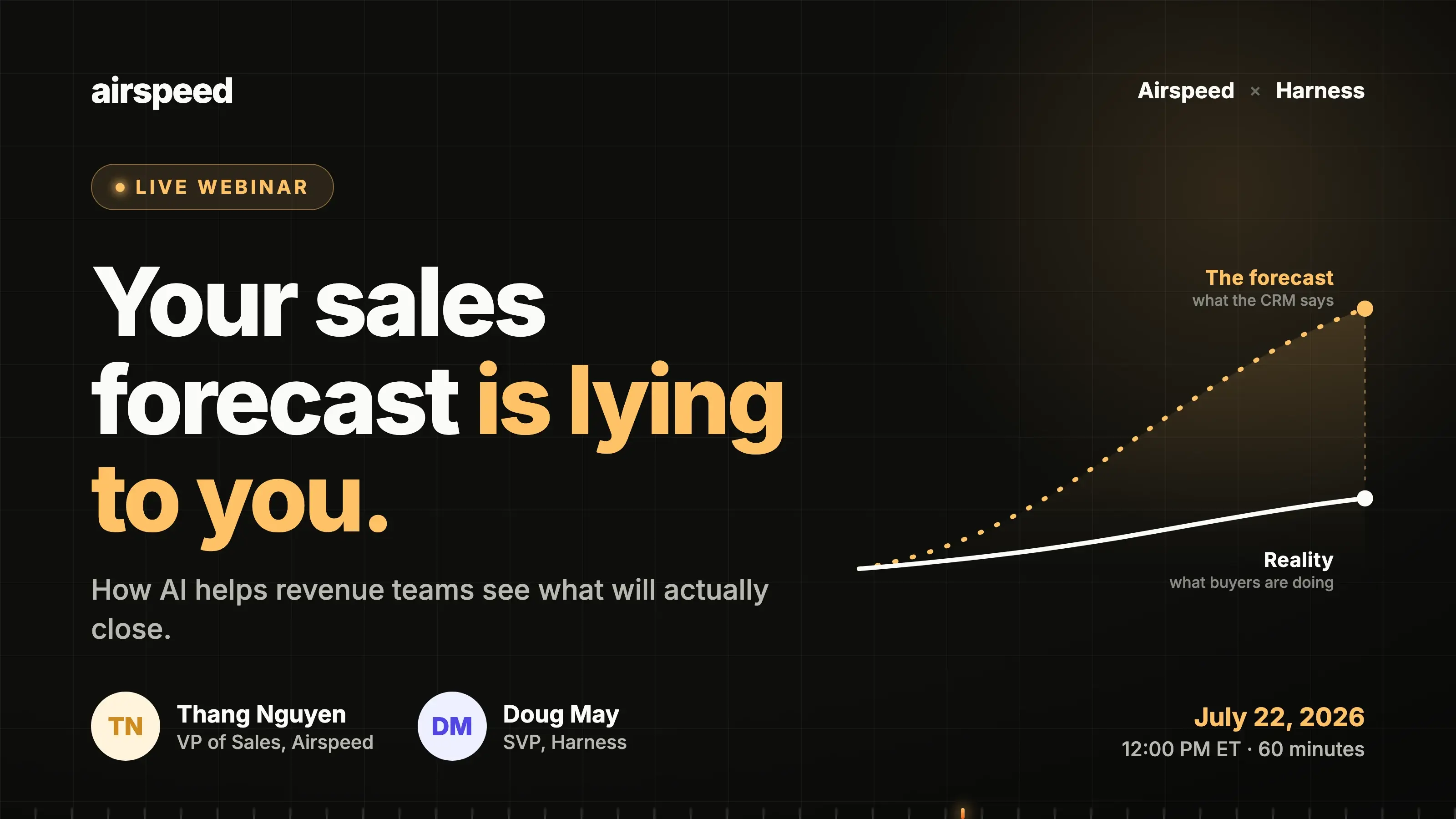
Why your sales forecast is lying to you (and what to do about it). Tuesday 28 July 2026 · 12:00-1:00 PM ET · Live
A live conversation with sales leaders on rebuilding trust in the numbers that run your business.
"This looks great; let me just loop in my team."
The rep updates the CRM. Moves the deal to late stage. Calls it 90% by end of quarter. Meanwhile, that prospect is in three other demos this week, hasn't aligned on budget internally, and their CFO has never heard of you.
Nobody's lying. The rep just doesn't have visibility into what's actually happening on the buyer's side. So the forecast looks healthy, the pipeline review feels optimistic, and then the quarter ends and everyone's scrambling to explain the miss.
This isn't a data problem. It's a context problem. Forecasting built on activity metrics instead of real buying signals is just structured guessing.
SPEAKERS Thang Nguyen, VP of Sales · Airspeed Doug May, SVP · Harness
WHAT WE'LL COVER → Why activity metrics lie and what buyer behaviour actually tells you. → The forecast vs. target confusion that's quietly killing team morale. → How to spot deal risk weeks before it shows up in your numbers. → What it looks like to rebuild forecasting credibility from scratch.
For sales leaders, RevOps, and anyone who's sat in a pipeline review thinking "these numbers don't feel right."
Attend live and get early access to Airspeed's forecasting module, plus your first month free.
03 · USING AIRSPEED
Surface expansion signals before your customer even asks.
Most CS and post-sale teams are sitting on a goldmine of expansion signals, and missing them because they're buried in call transcripts nobody has time to re-read.
In this walkthrough, Adam from Airspeed's Customer Success team shows three ways to surface upsell and expansion opportunities across your book of business:
INSIGHTS: Track specific signals (seats, new departments, budget mentions) automatically across every customer call.
ASK AIRSPEED: Query an account's full conversation and email history to find upsell angles on demand.
AGENTS: Scan your entire book of business at once and rank accounts by expansion potential.
If you're in Customer Success, Account Management, or running a post-sale revenue motion, this is how you stop missing the signals your customers are already giving you.
04 · COMPANY NEWS
OFFSITE: We're in Santorini. The team is together on the island for our summer offsite: good food, sunny days at the pool, and a lot of conversations about what comes next for you and the product. More soon.
05 · FROM THE FIELD
"Before Airspeed, I was losing 45 minutes before every call just pulling context together. Now my prep sheet is waiting for me. I'm showing up to conversations already knowing what matters."
Adam Bleck · Customer Success
06 · WHAT'S COMING UP
24 JUN: Series A Happy Hour · New York City Evening drinks with our NYC revenue ops community to celebrate the raise. Registration details coming shortly.
23 JUL: Pavilion GTM Dinner · San Francisco An evening with revenue leaders in SF. Good conversations, good food, no slides.
4 AUG: Pavilion GTM Dinner · Boston An evening with revenue leaders in Boston. Good conversations, good food, no slides.
15 OCT: Pavilion GTM Dinner · New York City An evening with revenue leaders in NYC. Good conversations, good food, no slides.

