


Getting an AI agent to write a follow-up email is the easy part. Getting it to pick the one follow-up that will move a deal this week is where most agents fall over.
That gap explains where agents are heading. Writing the email is execution. Knowing which email to write is judgment, and judgment depends on context gathered over time: your deals, your buyers, your playbook, what was said on last Tuesday’s call and what was promised in the email after it.
Our investors at DN Capital, who led our $20M Series A, put the thesis plainly in Memory is the moat: State of the Agent market (November 18, 2026): as models and execution commoditize, the durable value in agents will come from memory. We agree, and it is the idea Airbots are built on.
The agent market in 2026
Two questions sort the agent market. Who is the agent for: you as a person, or you at work with your team? And how do you use it: one agent you message about anything, or a builder where every task gets its own agent?
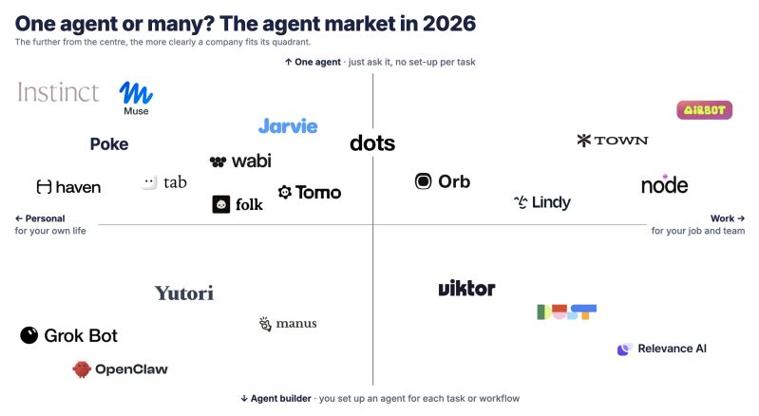
Market map: DN Capital, November 2026.
That gives four groups:
- Personal, one agent. Assistants you message about your own life, such as Poke, Instinct, Muse and Jarvie.
- Personal, agent builder. Tools where you configure agents for your own tasks, such as OpenClaw, Grok Bot, Yutori and Manus.
- Work, agent builder. Platforms where teams build an agent per workflow, such as Relevance AI and Viktor.
- Work, one agent. A single agent for your job that you just ask, such as Town, Node, Orb and Airbot.
The builder quadrants put the work on you. Each new workflow means a new agent, and each agent only knows what you tell it when you set it up. The top right works differently. Nobody configures the agent task by task, so it has to arrive knowing how you work and keep learning from there. That is a memory problem.
Execution is becoming a commodity
Drafting an email, summarizing a call, updating a CRM field, booking a meeting. A year ago these were impressive. Today almost every agent can do them, and the models behind them get better and cheaper every few months.
When every agent can do the same tasks, the tasks stop being the reason to choose one. What does not get cheaper is context that belongs to you: six months of calls on a deal, the way your team qualifies, the buyer who goes quiet before every signature. A newer model cannot download that on day one. It has to be built up, one interaction at a time.
That is why memory compounds. An agent that has worked alongside you for a quarter is more useful than one that started this morning, even if the newer one runs on a better model.
What memory means for a sales agent
For a sales team, memory is not a chat history. It is four kinds of context, held together:
- The deal. Every call, email and meeting, who the stakeholders are, which objections came up and what the agreed next step was.
- The playbook. How your team qualifies, what a healthy deal looks like at each stage, and what your best reps do that others don’t.
- The person. How you write, which deals you care about most, and what you would rather not be bothered with.
- The outcomes. Which deals closed, which were lost and why, and which signals turned out to matter.
With all four in place, the question “which follow-up matters this week?” has an answer. The agent knows the deal has stalled, knows the champion went quiet after pricing, knows your playbook says to bring in the economic buyer at this point, and knows how you would phrase that email.
We have written before about why memory is the missing ingredient in sales AI copilots. The same holds for agents, with higher stakes, because an agent acts on what it remembers.
How Airbot uses memory
Airbot is an AI chief of staff for sales, and it lives where you already are: WhatsApp or iMessage. There is no new tool to open and no dashboard to check.
Overnight, Airbot works on your deals. By morning, it texts you what it has done and the decisions it needs from you. During the day, you ask it what you would ask a colleague who knows your pipeline:
You: Which deals are dead?
Airbot: 4. Want me to tell the reps, or will you?
It can answer like that because it sits on top of Airspeed, which already captures your calls, emails and CRM data. From there, Airbot learns your playbook, your deals and the way you write, and it gets sharper with every interaction. Every edit you make to a draft teaches it your tone. Every suggestion you wave off tells it what to stop raising. Every deal that closes or slips shows it which signals were real.
The same applies to the forecast. Reps still want to shape their own numbers, so Airbot doesn’t take that away. It lets them adjust their forecast in a few simple messages, with the deal history already to hand.
How an agent earns more responsibility
Think about how you onboard a new rep. They shadow calls before they run them, and they work small deals before anyone gives them your biggest account. Agents should move up the same way.
At first, the agent only reports what it sees. Next, it recommends a move. Then it carries out the moves you approve. In time, for the decisions you have signed off on again and again, it goes ahead and lets you know after.
Memory is what carries an agent up that ladder. Each approval, correction and outcome adds to what it knows about how you work. An agent that forgets stays on the first rung for good, because it never builds the track record that would justify more. That is why Airbot asks for decisions rather than acting quietly in the background: every answer you give becomes part of that track record.
Try Airbot
Better models are coming, and the gap between agents on raw tasks will keep shrinking. What will separate them is how much of your business they have learned, and how well they use it.
Thank you to DN Capital for backing that view, and to everyone who has worked with Airbot so far.
If you lead a sales team and want an agent that learns your pipeline and gets sharper every week, you can get started at airbots.ai. Already on Airspeed? Book a demo and ask about Airbot for your team.
Frequently asked questions
Why does memory matter for an AI agent at work?
Execution tasks like drafting emails, summarizing calls, and updating CRM fields are becoming a commodity that every agent can do. Memory of your deals, your playbook, how you work, and past outcomes is what lets an agent decide which task matters, and it compounds over time.
What does memory mean for a sales agent?
Four kinds of context held together: the deal (every call, email, stakeholder, and next step), the playbook (how your team qualifies and what a healthy deal looks like), the person (how you write and what you care about), and the outcomes (which deals closed or were lost, and which signals mattered).
How does Airbot use memory?
Airbot sits on top of Airspeed, which already captures your calls, emails, and CRM data. It learns your playbook, your deals, and the way you write, and it gets sharper with every draft you edit, suggestion you skip, and deal that closes.


