


Your sales team is one of the richest sources of product signal you have. Reps sit in front of buyers every day, hear the objections, watch deals stall, and field the requests that point at real friction. They’re also one of the easiest sources of noise to mistake for signal.
This post breaks down how to evaluate feature requests from sales: what data to collect, how to separate urgency from importance, and a decision framework that turns raw requests into prioritization calls you can defend.
Why Sales Feature Requests Are Hard to Trust
The problem isn’t that sales reps are wrong. It’s that their incentives create systematic bias in how they report requests.
When a rep is trying to close a deal, a missing feature can feel like the single thing standing between them and a signature. That shapes how they communicate it: urgent, high-impact, blocking everything. The same feature, reported by a rep who isn’t under quarter-end pressure, might not even come up.
This creates three common prioritization traps:
The loudest request wins. High-urgency framing bumps a feature up the backlog. It ships. The deal closes, or doesn’t, for reasons unrelated to the feature.
Pattern blindness. Without systematic tracking, you can’t tell whether a request came up once or fifty times. Recurring friction gets treated like one-off feedback.
Severity mislabeling. Almost everything from sales arrives framed as a critical blocker. “Would be nice to have” rarely gets said out loud, even when that’s what it is.
What Data to Collect Before Prioritizing
Before any feature request enters a prioritization discussion, collect answers to these five questions:
1. How many deals mention this?
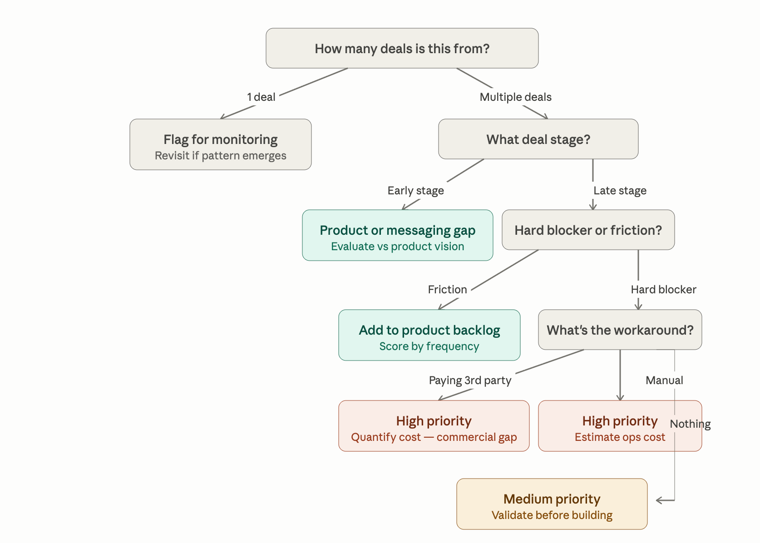
A single request from a single rep is weak signal. The same request appearing across five, ten, or twenty deals is a pattern. Track feature mentions at the deal level, not the rep level.
2. At what stage does it come up?
A feature that surfaces in late-stage deals (legal review, procurement, final evaluation) carries higher immediate revenue impact than one raised in early discovery. Stage data lets you weigh urgency and importance separately.
3. Is it a blocker or friction?
There’s a meaningful difference between “we cannot move forward without this” and “this would make things easier.” Both matter, but they belong in different prioritisation tracks. Blocked deals have a time cost; friction has a conversion cost.
4. What is the customer currently doing instead?
The workaround is often the clearest indicator of real impact. If a customer is paying a third-party tool to solve the gap, or their team is manually handling the workflow every day, the financial and operational cost is concrete, not estimated.
5. Does this appear in won deals or only lost ones?
If a feature is absent from your closed-won accounts, it’s probably not the decision factor it’s being presented as. Cross-referencing against won/lost data is one of the most reliable ways to separate genuine blockers from negotiating points.
A Decision Framework for Feature Requests
Use this tree to evaluate any inbound request from sales before it enters your planning process.
What “Objective Data” Actually Means Here
The framework is only as good as the data feeding it. For most teams that data is scattered: call notes, Slack threads, CRM fields filled in when someone remembered, and the memory of whoever was in the room.
The fix is to track feature mentions across every sales conversation, from the calls themselves, not from rep reports. When you can see a request appeared in 14 late-stage deals over the last 90 days, three of them lost, and the common workaround is a paid third-party tool, that’s a prioritization brief, not an opinion.
Teams that work this way report the same shift: they stop building what seemed urgent and start building what actually moves deals.
The Question That Remains Hard
Even with good data, one tension doesn’t resolve cleanly: customer-driven features vs. vision-driven features.
Objective data tells you what’s blocking revenue today. It doesn’t tell you what capabilities will define your product in 18 months. Both matter. The framework above helps you be more rigorous about the customer side of that equation, which at least ensures the tradeoff is made consciously, rather than by default.
That’s not a full answer. But it’s a better starting position than trusting whoever shouted loudest last quarter.
Key Takeaways
- Track feature mentions at the deal level, not the rep level
- Separate urgency (deal stage, deal count) from importance (workaround cost, won/lost correlation)
- A request from one rep is a data point. A pattern across 10+ deals is signal worth acting on
- The workaround is your clearest evidence of real impact
- Cross-reference against won deals before treating anything as a critical blocker
Frequently asked questions
Why are feature requests from sales hard to trust?
Not because reps are wrong, but because their incentives create systematic bias in how requests get reported. A missing feature in a live deal feels like the one thing standing between the rep and a signature, so it arrives labelled urgent, high-impact, and blocking, whether or not it is.
What data should you collect before prioritizing a feature request?
Five answers. How many deals mention it, tracked at deal level rather than rep level. What stage it comes up at. Whether it is a blocker or friction. What the customer is doing instead today. And whether it appears in won deals or only lost ones.
How do you tell a genuine blocker from a negotiating point?
Cross-reference against won and lost data. If a feature is absent from your closed-won accounts, it is probably not the decision factor it is being presented as. The customer's current workaround is the other strong tell: a third-party tool they pay for, or a workflow someone handles manually every day, is concrete cost rather than estimated.
Where should feature-mention data come from?
The calls themselves, not rep reports. For most teams the data is scattered across call notes, Slack threads, CRM fields filled in when someone remembered, and the memory of whoever was in the room. Tracking mentions across every sales conversation removes the reporting bias from the input.


