
Most GTM stacks are good at storing data. CRMs capture activities. Call recording tools transcribe conversations. Email platforms log engagement. Support tools track tickets.
What they’re not good at is connecting any of it into a coherent picture of what’s actually happening across your commercial motion — and acting on it automatically.
That gap is what a commercial brain is designed to close. This post explains what the concept means, how it differs from existing tooling, and what it takes to build one.
What Is a Commercial Brain?
A commercial brain is a persistent intelligence layer that aggregates signal from across every channel where commercial information lives — calls, emails, CRM, support, web signals — and builds a structured, continuously updated understanding of your buyers, your competitive landscape, and what drives your wins and losses.
The term distinguishes it from two things it’s often confused with:
A CRM stores records. A commercial brain understands patterns. CRM tells you a deal is in “Stage 4.” A commercial brain tells you deals in Stage 4 that match this account profile, where the champion has gone quiet, close at 23% unless leadership gets involved.
A call intelligence tool summarises individual conversations. A commercial brain synthesises across all of them. A call summary tells you what was said in one meeting. A commercial brain tells you that competitor X has come up in 34% of late-stage deals this quarter — up from 12% last quarter.
The key properties are aggregate intelligence (understanding built from many interactions, not one) and persistent memory (the picture updates continuously, not just when someone runs a report).
What Signal Goes In
A commercial brain is only as useful as the signal it’s built on. The core data sources are:
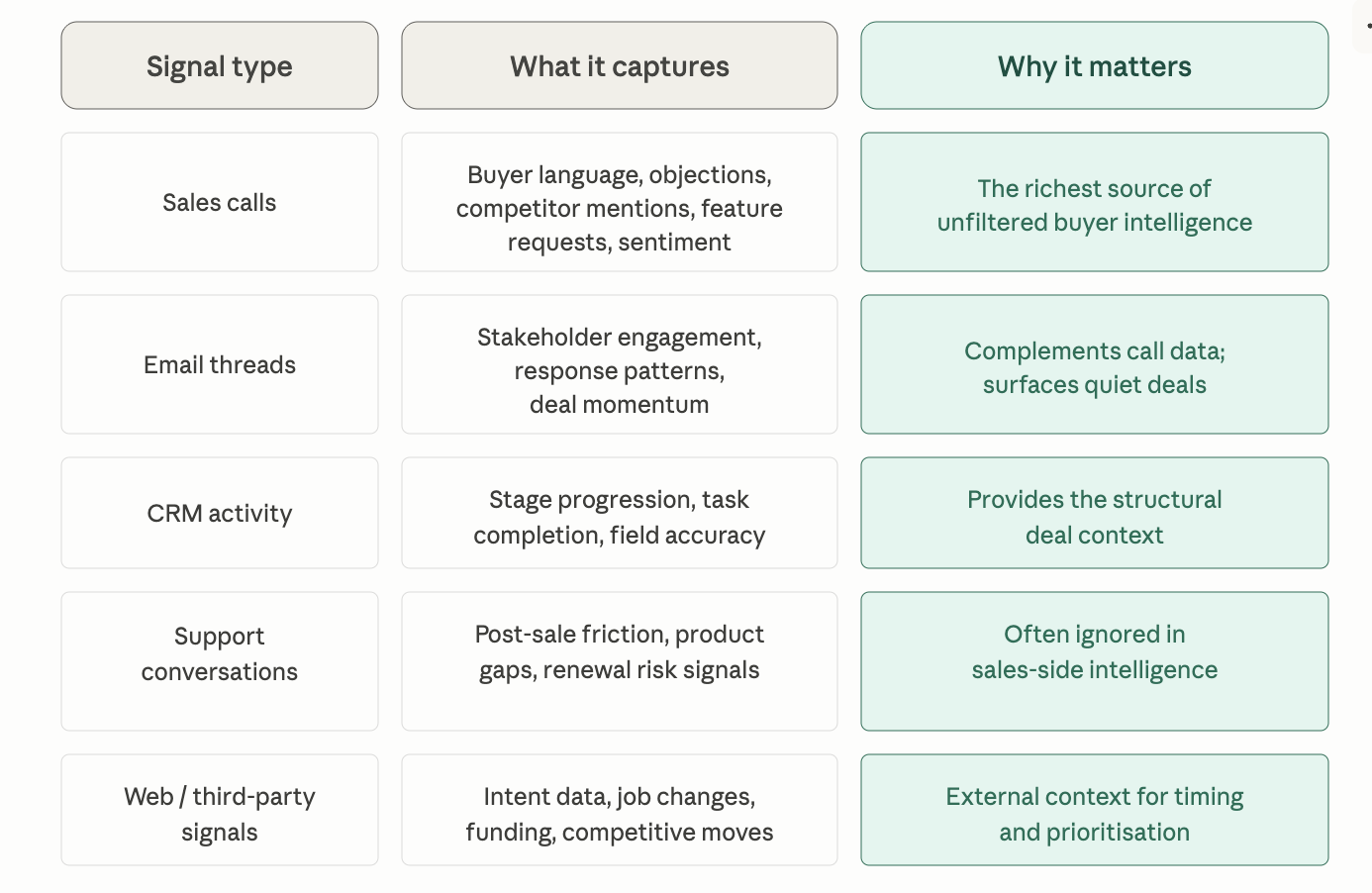
The value compounds as more sources connect. A stalled deal looks different when you can see that the champion changed jobs, the last three emails went unanswered, and the account opened a support ticket about a core feature two weeks ago.
How It Differs from a Traditional GTM Stack
Most revenue teams have all of the above data — it’s just siloed. The gap isn’t data collection. It’s aggregation, interpretation, and action.
Here’s how the two approaches compare:
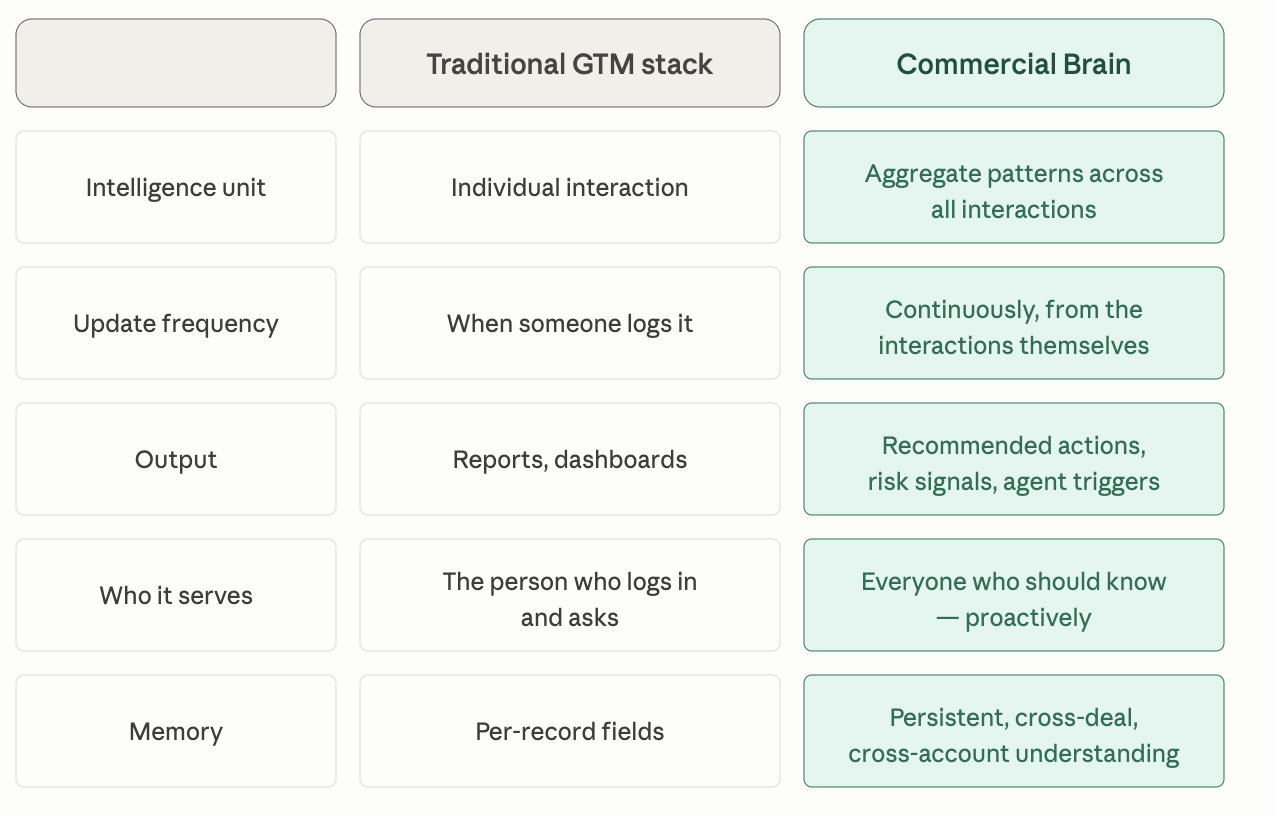
The practical effect: traditional stacks require someone to know what to look for. A commercial brain surfaces what matters before anyone thought to ask.
Why Context Has to Come Before Agents
There’s been a wave of GTM agent platforms in the past 18 months. Most of them went straight to the automation layer: configure a workflow, connect your CRM, run your sequences.
The limitation is that agents are only as good as the context they operate in. An agent that doesn’t know your ICP, your competitive differentiators, your product gaps, or what language your best customers use — can automate tasks, but can’t make good judgments.
This is why building the commercial brain first matters. When agents are grounded in deep, company-specific context, they can do things generic platforms can’t: draft re-engagement emails that reference the specific objection raised on a call three months ago, flag a deal risk based on a pattern that matches previous losses, or prioritise outbound targets based on signals that closely resemble your actual closed-won accounts.
Context-first is not the fast path to shipping. But it’s the path to agents that are accurate and trusted — rather than impressive in a demo and unreliable in production.
What It Takes to Build One
Building a commercial brain requires four things:
1. Data infrastructure. Integrations that pull from every commercial channel and keep data current. CRM sync, call recording platforms, email providers, support tools, intent data providers.
2. A structured representation layer. Raw transcripts and activity logs are not intelligence. The data needs to be parsed, categorised, and stored in a way that supports pattern-matching and retrieval — not just keyword search.
3. Aggregate analysis. The intelligence layer that looks across deals, accounts, and interactions to surface patterns: competitor trends, feature friction, deal risk signals, onboarding gaps.
4. An action layer. The commercial brain becomes operationally valuable when it connects to agents or workflows that act on its intelligence — not just surfaces it in a dashboard that someone has to remember to check.
Key Takeaways
- A commercial brain is a persistent, aggregate intelligence layer — not a CRM, not a call tool
- Its value comes from connecting signal across channels, not storing it in silos
- Context has to come before automation — generic agents without company-specific grounding can’t make good judgments
- The four components are: data infrastructure, structured representation, aggregate analysis, and an action layer
- Teams that build this foundation first ship agents that are trusted, not just impressive